
925 Silver Jewelry Hallmarks: What B2B Buyers Should Check
925 Silver Jewelry Hallmarks: What B2B Buyers Should Check
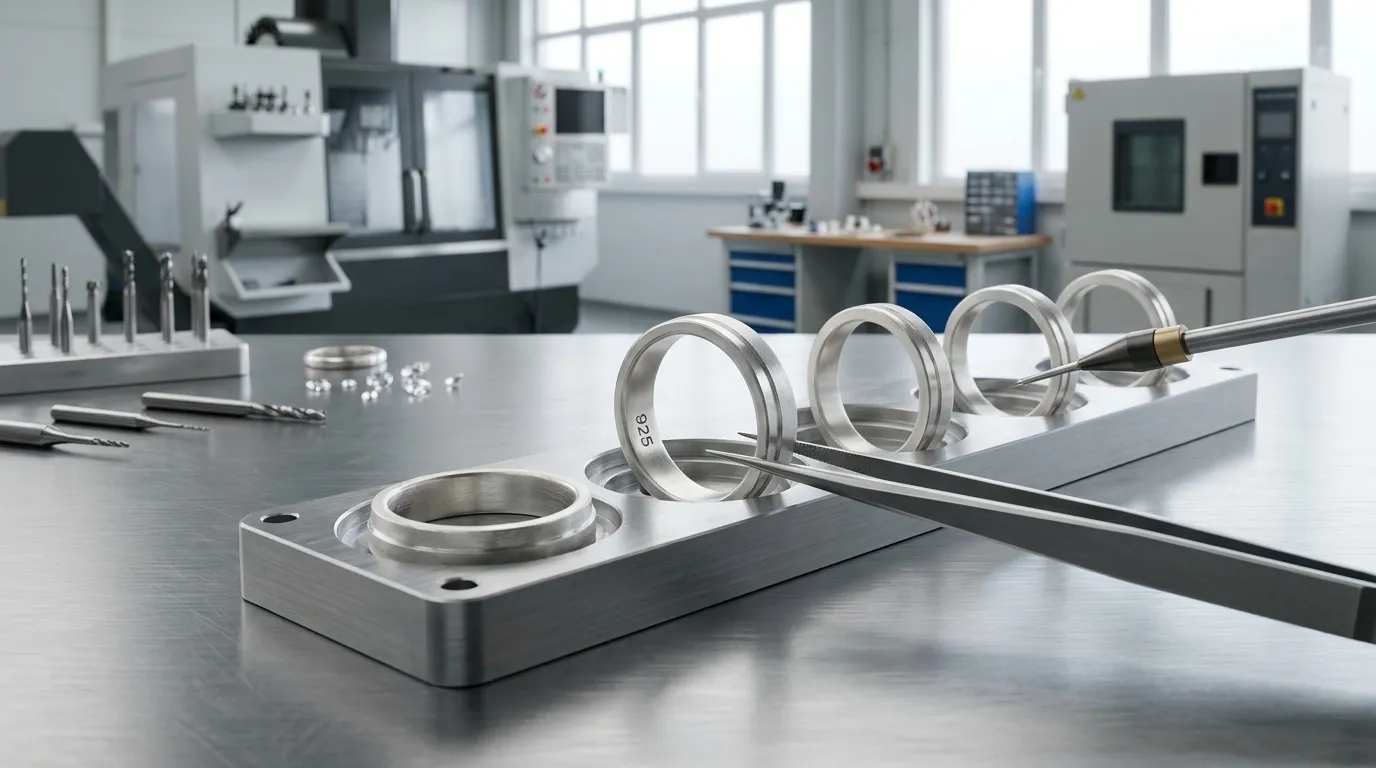
If you are sourcing 925 silver jewelry for your brand, a small “925” stamp can look like a simple authenticity check.
It is not.
The number tells you something important about the claimed silver content, but it does not tell you everything you need to know before placing a production order.
When you are buying hundreds or thousands of pieces for a collection, you need to know more than whether a product has “925” stamped somewhere. You need to understand what the mark represents, whether the material specification matches your order, whether the marking is appropriate for your target market, and what evidence your manufacturer can provide.
At SSJew, we treat the silver specification as part of the production requirement rather than as a decorative marking added at the end of production.
Here is what you should check before approving your next 925 silver jewelry order.
What the 925 Mark Actually Means
The first thing to understand is simple:
925 means 925 parts of silver per 1,000 parts of metal.
That equals:
-
92.5% pure silver
-
7.5% other alloying metals
-
925/1000 fineness
The remaining 7.5% is not automatically a sign that the jewelry is lower quality. Pure silver is relatively soft, so sterling silver is normally alloyed with other metals to provide properties needed for jewelry manufacturing.
In the United States, the FTC states that products represented as “Sterling Silver,” “Sterling,” or “Sterling Silver” should contain at least 925/1000 pure silver. The FTC also notes that silver products may be marked “925,” meaning 925 parts per thousand are pure silver.
925 Is a Fineness Mark — Not Always a Complete Hallmark
This distinction matters when you source internationally.
A 925 mark communicates silver fineness.
A hallmark, however, can mean a broader system of independently verified marks required by a particular market.
The UK is a good example.
For silver articles above the UK's exemption weight of 7.78 grams, hallmarking requirements generally apply. A complete UK hallmark contains three compulsory marks, including a sponsor's or maker's mark, a fineness mark and an assay office mark.
So if you are selling into the UK, you should not assume:
“The product has 925 stamped on it, therefore it has a UK hallmark.”
Those are not necessarily the same thing.
The 925 Number Does Not Tell You the Whole Product Specification
A 925 stamp also does not automatically tell you:
-
whether every major metal component is sterling silver
-
whether findings or structural components use other materials
-
whether the product has been plated
-
what surface finish was specified
-
whether the product was tested
-
whether the marking meets the requirements of your target market
-
whether the actual production material matches the approved specification
This is why B2B buyers should treat the hallmark or fineness mark as one verification point, not the entire supplier evaluation process.
What You Should Check on a 925 Silver Jewelry Sample
When you receive a sample from a manufacturer, do not check only whether you can find “925.”
Use the sample as a physical verification point before moving into bulk production.
Check the Fineness Mark
First, confirm whether the product is marked appropriately for your product specification and target market.
Look for:
925
or another applicable silver fineness designation.
The mark should be clear enough to identify without damaging the product or compromising the design.
For small products, the available marking area can be limited. This is where your manufacturer should confirm the marking approach during development rather than discovering the problem after production.
What you should ask your manufacturer:
“Where will the silver fineness mark be placed, and what marking will be used for this product?”
At SSJew, this is best handled during the product development and sampling stage, when the design, dimensions and production requirements are being confirmed.
Check Which Parts Are Actually Silver
This is one of the most important checks for B2B buyers.
A jewelry product can contain multiple components:
-
main body
-
pendant bail
-
chain
-
clasp
-
posts
-
backs
-
jump rings
-
decorative elements
-
stone-setting components
Do not assume that one 925 stamp automatically means every component is made from sterling silver.
For example, if your product is marketed as sterling silver jewelry, you need to understand the material specification of the components that matter to your product claim and customer expectations.
Ask your manufacturer:
“Which components are 925 sterling silver, and which components use other materials?”
A clear material specification is more useful than a simple product title saying “925 Silver.”
Check the Marking Against the Approved Sample
Your approved sample should become a reference point for bulk production.
Compare:
-
mark position
-
mark size
-
mark clarity
-
product structure
-
material specification
-
surface finish
-
plating
-
engraving
-
stone setting
The goal is not simply to make sure the word “925” exists.
The goal is to make sure the production specification represented by the sample is carried into bulk production.
A 925 Stamp Does Not Replace Material Verification
This is where B2B sourcing becomes different from consumer shopping.
If you are buying one necklace for yourself, seeing “925” may be enough to continue your purchase.
If you are buying jewelry for a brand, you have a different problem.
You need to be able to stand behind the product specification you communicate to your customers.
A stamped mark is therefore only one part of your material-control process.
Ask for Material Documentation When Your Market Requires It
Depending on your market, product category and internal compliance process, you may need supporting documentation such as:
-
material specifications
-
supplier material declarations
-
test reports
-
assay or fineness documentation
-
restricted-substance testing
-
batch-related documentation
The exact documentation you need depends on your target market and product requirements.
At SSJew, we would rather work from a defined material specification than leave the material description open to interpretation during production.
Your requirement should be clear before bulk production starts.
Understand the Difference Between Material Purity and Product Compliance
This is an important distinction.
A product can satisfy a silver fineness requirement and still require additional compliance checks for the market where you sell it.
For example, EU REACH restricts nickel release from certain jewelry articles that have direct and prolonged skin contact. For pierced-ear posts, the migration limit is 0.2 μg/cm²/week; for certain other prolonged skin-contact articles, the limit is 0.5 μg/cm²/week.
That means:
925 silver specification ≠ complete regulatory compliance.
Your sourcing checklist should therefore separate:
Material Fineness → Component Materials → Surface Treatment → Restricted Substances → Market Requirements
This distinction can prevent a common procurement mistake: assuming that one material mark proves every compliance requirement.
Hallmark Requirements Depend on Where You Sell
If your jewelry is sold internationally, do not use one universal hallmark rule for every market.
The marking requirements can vary.
United States
For U.S. marketing, the FTC Jewelry Guides are particularly relevant to how silver content is represented.
The FTC states that:
-
“Sterling Silver” and “Sterling” indicate at least 925/1000 pure silver
-
“925” represents 925 parts per thousand pure silver
-
silver-plated products are different because they contain a silver layer applied over a base metal
The practical B2B lesson is:
Do not describe a plated base-metal product as sterling silver simply because its surface looks silver.
The material claim needs to match the underlying product.
United Kingdom
The UK uses a more formal hallmarking system.
For silver, the current exemption weight is 7.78 grams. Silver articles above that threshold generally require a legally recognized hallmark when sold as precious-metal articles in the UK.
A complete UK hallmark includes:
-
Sponsor's or maker's mark
-
Fineness mark
-
Assay office mark
The silver fineness mark is 925, representing 925 parts per thousand silver.
However, the 7.78g threshold is specifically a UK rule. You should not automatically apply it to another European market.
UK government guidance explicitly notes that exemption weights can differ between countries.
H3: EU Markets Require Market-Specific Checking
There is no single “925 hallmark rule” that you should blindly apply across every European country.
Requirements can differ by country.
For example, UK government guidance notes that countries including France, Spain and Belgium have their own hallmarking requirements, while Germany and Luxembourg do not require hallmarking as a pre-market authorization in the same way.
For you as a buyer, the practical rule is:
Tell your manufacturer where the jewelry will be sold before production starts.
The target market can affect the marking and compliance requirements that need to be considered during product development.
How We Help You Control 925 Silver Jewelry Specifications
A hallmark is most useful when it is connected to a controlled production specification.
At SSJew, we approach custom silver jewelry development around that connection.
H3: Start With a Defined Material Specification
Instead of treating “925 silver” as a generic product label, we can define the material requirement as part of the product specification.
Your specification can cover:
-
silver fineness
-
component materials
-
product structure
-
surface finish
-
plating requirements
-
marking requirements
-
stone-setting requirements
-
packaging requirements where applicable
This gives your team a clearer reference when reviewing samples and approving production.
H3: Confirm the Product Through Sampling
A sample gives you a physical reference before you commit to bulk production.
At SSJew, the development process can move from:
Design → CAD → Sample → Approval → Production
This allows you to check the physical product before production quantities increase.
For you, that means potential issues can be identified at the sample stage rather than after the finished inventory arrives.
H3: Carry the Approved Specification Into Bulk Production
The real procurement risk is not only:
“Can the manufacturer make one correct sample?”
It is:
“Can the manufacturer reproduce the approved product when the order becomes production?”
This is where material specification, production records and QC become important.
At SSJew, our goal is to keep the approved product specification connected to the production process so that the bulk order is not treated as a completely new interpretation of the design.
Your 925 Silver Hallmark Checklist Before Bulk Production
Before approving your order, use this checklist with your manufacturer.
Material
-
Is the product actually 925 sterling silver?
-
Is the silver specification clearly documented?
-
Which components are sterling silver?
-
Are any components made from other materials?
-
Does the material specification match your product description?
Marking
-
Is a 925 or applicable fineness mark required?
-
Where will the mark be placed?
-
Does the mark fit the product design?
-
Does your target market require a formal hallmark?
-
Does the marking requirement differ because of product weight or category?
Testing and Documentation
-
Can the manufacturer provide applicable material documentation?
-
Is testing required for your target market?
-
Do you need restricted-substance testing?
-
Do the documents correspond to the actual product specification?
-
Can the documentation be retained for future reorders?
Production Consistency
-
Does the approved sample show the final material and finish?
-
Can the marking be reproduced consistently?
-
Are the material requirements carried into bulk production?
-
Can the manufacturer use the approved sample as a production reference?
-
Can repeat orders follow the same specification?
What a 925 Mark Can — and Cannot — Tell You
What You See
What It Can Tell You
What You Still Need to Verify
925
Represents 925 parts per thousand silver
Whether the product specification and claim are accurate
Sterling Silver
Indicates a minimum 925/1000 silver content under U.S. FTC guidance
Whether other product components and market requirements are properly addressed
Silver Plating
Indicates a silver layer over another base material
Base-metal composition and plating specification
UK Hallmark
Indicates independent hallmarking under the UK system
Whether the product meets the correct UK requirements for its category
Material Test Report
Provides analytical evidence for the tested material
Whether the tested sample represents the production product
Approved Sample
Gives you a physical production reference
Whether bulk production remains consistent with it
The important point is that no single mark or document answers every procurement question.
Your strongest sourcing process combines the product specification, physical sample, applicable marking requirements and appropriate evidence.
The Right Question Is Not “Does It Have 925?”
If you are sourcing custom 925 silver jewelry, a better question is:
“Can you show me how the 925 specification is controlled from material selection through sampling and bulk production?”
That question changes the conversation.
You are no longer checking a stamp in isolation.
You are checking whether your manufacturer has a production system that connects:
Material Specification → Product Development → Marking → Sample Approval → Production → QC → Documentation
At SSJew, this is how we recommend approaching custom silver jewelry procurement.
A 925 mark is important.
But for your brand, the production system behind that mark matters more.
If you already have a design, reference sample or product specification, you can send it to our team for review and discuss the material, marking and production requirements before moving into sampling.