
Brass Jewelry Manufacturing Standards for International Brands
Brass Jewelry Manufacturing Standards for International Brands
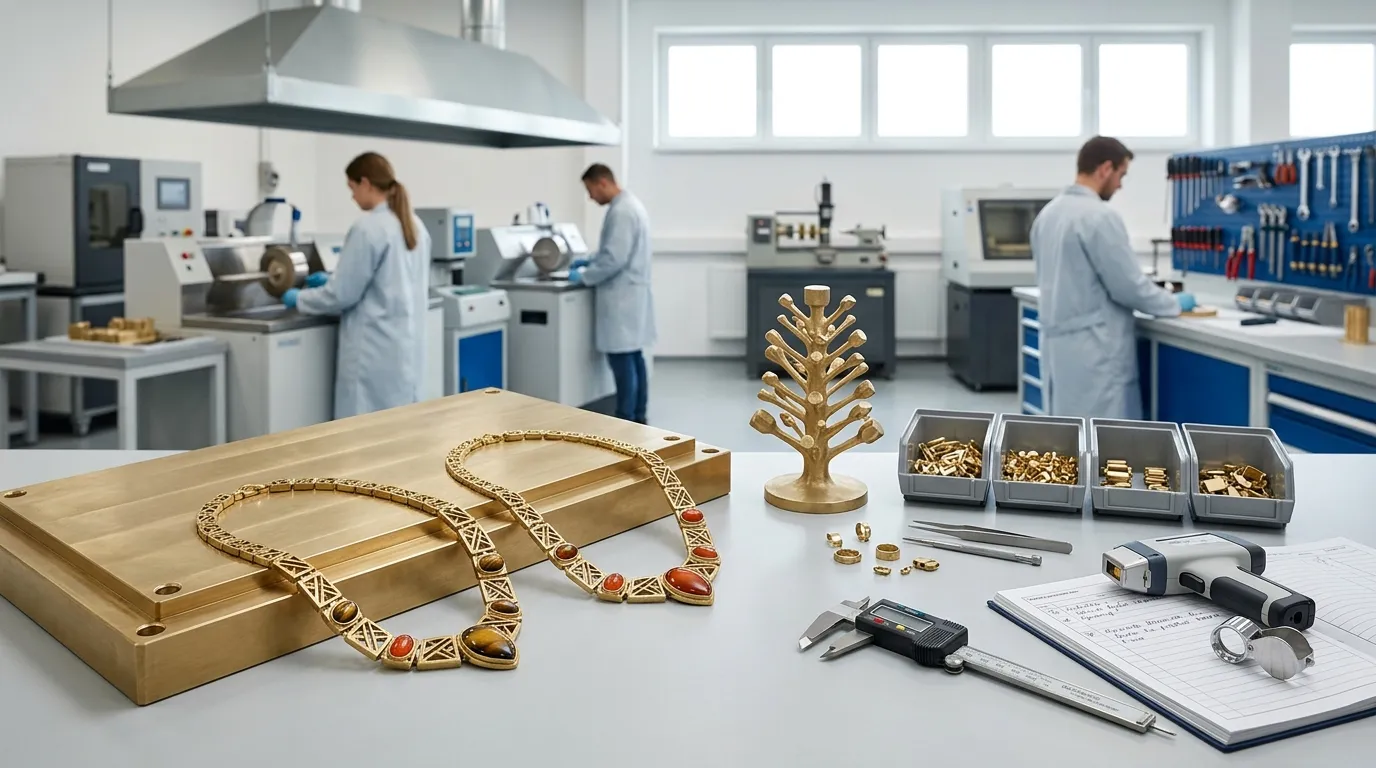
When you source brass jewelry for an international market, the material itself is only the starting point.
You also need to know what brass alloy is being used, whether restricted substances are controlled, how the surface is finished, whether plating can remain consistent from batch to batch, and whether the manufacturer can reproduce your approved sample during mass production.
For you as a jewelry brand, these details directly affect product consistency, customer complaints, returns, compliance risk, and the cost of future reorders.
At SSJew, we approach brass jewelry manufacturing from the production side. We look at the material, structure, finishing, plating, inspection, and repeat production as connected parts of the same manufacturing process.
This guide explains the main standards and checkpoints you should evaluate before choosing a brass jewelry manufacturer.
Brass Is an Alloy Specification, Not a Single Material
One of the first mistakes buyers make is treating “brass” as a single standardized material.
Brass is primarily a copper-zinc alloy, but the actual composition can vary significantly depending on the alloy grade and manufacturing process.
That difference matters because alloy composition can affect:
-
Color
-
Hardness
-
Machinability
-
Casting behavior
-
Surface finishing
-
Plating performance
-
Weight
-
Chemical compliance
Common Brass Alloy Compositions
For example, C26000 cartridge brass is specified at approximately 68.5–71.5% copper, with zinc making up the balance and a maximum lead content of 0.07% under the referenced UNS composition.
By comparison, C36000 free-cutting brass contains approximately 60–63% copper and 2.5–3.0% lead, with zinc making up most of the remainder.
That difference is important for jewelry buyers.
A brass alloy selected for machining efficiency is not automatically the right choice for jewelry intended for international consumer markets.
The material specification should therefore be confirmed before production rather than simply written as “brass” on a purchase order.
What You Should Ask Your Manufacturer
Before approving a brass material, ask your manufacturer to provide:
-
Alloy or material specification
-
Copper and zinc composition
-
Lead content
-
Cadmium content
-
Nickel content where relevant
-
Material testing documentation
-
Intended surface finish
-
Applicable market requirements
At SSJew, our approach is to confirm the material specification before production rather than treating the base metal as an undefined production input.
Buyer takeaway:
If your supplier cannot clearly tell you what brass alloy is being used, you do not yet have enough information to evaluate the material risk.
International Compliance Starts With the Base Metal
For international jewelry brands, compliance cannot be solved simply by adding a protective plating layer.
You need to consider the base metal, surface coating, product construction, intended consumer, and destination market together.
The applicable requirements also differ by market.
EU REACH Lead and Nickel Requirements
Under EU REACH Annex XVII, jewelry articles and individual components cannot be placed on the market if the lead concentration in an individual part reaches 0.05% by weight or higher, equivalent to 500 ppm. The restriction applies to jewelry and imitation jewelry, including bracelets, necklaces, rings, piercing jewelry, watches, brooches, and cufflinks.
Nickel is regulated differently.
For articles intended for direct and prolonged skin contact, the nickel release rate must not exceed 0.5 μg/cm²/week. For piercing posts, the limit is 0.2 μg/cm²/week. EU rules also address coated articles, requiring the coating to maintain the required nickel-release performance for at least two years of normal use.
This is why “nickel-free plating” should not be treated as a sufficient compliance statement by itself.
You need to understand the actual product construction and testing requirements.
U.S. Requirements Depend on the Product Category
The United States does not have one single federal jewelry regulation covering every adult jewelry product.
The U.S. Consumer Product Safety Commission identifies ASTM F2999 as the consensus safety specification for adult jewelry and ASTM F2923 for children's jewelry.
Children's jewelry has additional requirements.
For children's products, accessible components must contain no more than 100 ppm total lead under the federal lead-content requirement.
Therefore, if you sell brass jewelry for children, you should not use the compliance approach designed for ordinary adult fashion jewelry.
California Proposition 65 Requires an Exposure-Based Approach
California Proposition 65 is another consideration for brands selling into California.
OEHHA lists a Proposition 65 safe-harbor level for lead of 0.5 μg/day for oral exposure and a maximum allowable dose level for cadmium of 4.1 μg/day.
For lead-containing jewelry, OEHHA specifically states that manufacturers and importers must provide a warning when exposure exceeds the applicable safe-harbor level.
The practical lesson for you is simple:
Do not ask only whether the brass is “compliant.” Ask which market, which product category, which substance, which test method, and which requirement the manufacturer is referring to.
Brass Jewelry Manufacturing Requires Control Beyond Material Selection
Once the material is approved, the next risk is manufacturing consistency.
A brass jewelry design can pass a sample review and still create problems during mass production if the manufacturer does not control the production process.
At SSJew, we look at the manufacturing sequence as a connected system:
Design → CAD → Prototype → Production → Polishing → Plating → QC → Shipment
Each stage can introduce a different type of variation.
Design and CAD Control
A production-ready CAD file should define the physical structure of the jewelry rather than only showing how the finished product should look.
For brass jewelry, important details can include:
-
Wall thickness
-
Link dimensions
-
Hole sizes
-
Connection points
-
Stone-setting structures
-
Engraving depth
-
Surface details
-
Weight targets
A design that looks correct visually may still create production problems if the structure is too thin, difficult to cast, difficult to polish, or difficult to assemble.
Our CAD and sampling process is intended to identify these issues before they become bulk-production problems.
Casting, Assembly and Surface Finishing
Depending on the design, brass jewelry may involve processes such as:
-
Casting
-
CNC or machining
-
Cutting
-
Soldering
-
Assembly
-
Stone setting
-
Polishing
-
Surface finishing
-
Plating
The important point for you is not simply whether a factory offers these processes.
You should ask how the manufacturer controls the specifications between processes.
For example, excessive polishing can change dimensions or soften sharp details. Inconsistent preparation before plating can create visible differences in color and surface appearance.
Quality Control Should Start Before Final Inspection
A final inspection cannot completely compensate for problems introduced earlier in production.
Our QC framework should therefore cover multiple stages:
Material Inspection → Production Inspection → Surface Inspection → Final Inspection
Typical checkpoints include:
-
Material specification
-
Product dimensions
-
Weight
-
Stone security
-
Welding or connection points
-
Surface finishing
-
Plating appearance
-
Quantity
-
Packaging
The exact number of checkpoints, inspection tolerances, defect rate, and inspection-team structure should be verified from SSJew's actual internal QC records before being published as company-specific claims.
Plating Quality Is a Manufacturing Standard, Not Just a Color Choice
For many brass jewelry brands, the final product is not sold as bare brass.
It may use:
-
Gold plating
-
Silver plating
-
Rhodium plating
-
Black plating
-
Other decorative finishes
That means the plating process becomes one of the most important parts of the finished product.
Surface Preparation Determines Plating Performance
Before plating, the brass surface needs to be properly prepared.
The manufacturing sequence can include:
Polishing → Cleaning → Base/Barrier Layers → Decorative Plating → Final Inspection
If the substrate is not properly prepared, plating may show:
-
Uneven color
-
Poor adhesion
-
Visible surface defects
-
Early wear
-
Tarnishing or discoloration
-
Different appearance between batches
This is why two brass products using the same nominal gold color can still look significantly different.
Plating Specifications Should Be Documented
When you place an order, avoid specifying only:
“Gold plated brass.”
That description is not precise enough for repeat production.
A better production specification should define, where applicable:
-
Base material
-
Plating color
-
Plating system
-
Layer structure
-
Plating thickness requirement
-
Surface preparation
-
Adhesion requirement
-
Tarnish or wear testing requirement
-
Applicable chemical restrictions
At SSJew, these specifications can be tied to the approved sample so that future production has a defined reference rather than relying only on visual memory.
Buyer benefit:
A documented finishing specification reduces ambiguity when you reorder the same design months later.
Sample-to-Bulk Consistency Is the Real Manufacturing Test
A brass jewelry sample can look excellent.
The more important question for you is:
Will the 1,000th piece look and perform like the approved sample?
That is where manufacturing systems become more important than sample appearance.
What Can Change Between Sample and Bulk Production?
Mass production can introduce variation in:
-
Product dimensions
-
Weight
-
Brass composition
-
Casting quality
-
Stone setting
-
Polishing
-
Plating color
-
Surface texture
-
Assembly
-
Final appearance
If these variables are not controlled, your first production order may look different from the sample you approved.
That creates a much larger commercial problem than a single defective piece.
It can lead to:
-
Product photography no longer matching the product
-
Customer complaints
-
Higher return rates
-
Rework
-
Replacement costs
-
Delayed launches
-
Inconsistent repeat orders
Reorders Need Production Records
For a growing jewelry brand, the first order is only part of the relationship.
You may reorder the same necklace six months later.
At that point, the manufacturer should be able to reproduce the product using documented information such as:
-
Approved CAD
-
Material specification
-
Product dimensions
-
Weight reference
-
Stone specification
-
Plating specification
-
Finishing requirements
-
QC standards
-
Approved sample reference
Our goal at SSJew is to use the approved production information as the reference for future orders instead of treating every reorder as a completely new product.
What International Brands Should Request Before Ordering Brass Jewelry
Before approving a brass jewelry manufacturer, you should be able to answer the following questions.
Material Checklist
Ask for:
-
Brass alloy specification
-
Material composition
-
Lead and cadmium information
-
Nickel information where applicable
-
Material test reports
-
Product-specific compliance documentation
Manufacturing Checklist
Confirm whether the manufacturer can provide:
-
CAD development
-
Production feasibility review
-
Samples
-
Material confirmation
-
Production inspection
-
Surface-finishing control
-
Plating control
-
Final QC
-
Repeat-production records
Compliance Checklist
Define your destination market before testing.
For example:
Requirement
Key Point for Buyers
EU REACH – Lead
Lead concentration in an individual jewelry part must be below 0.05% by weight
EU REACH – Nickel
≤0.5 μg/cm²/week for prolonged skin-contact articles
EU Piercing Jewelry
≤0.2 μg/cm²/week nickel release
U.S. Children's Products
≤100 ppm total lead in accessible components
California Prop 65
Exposure-based warning requirements may apply to listed chemicals
ASTM F2999
Adult jewelry safety specification covering specified elements and mechanical hazards
The exact requirement should always be checked against the current regulation and the specific product you intend to sell. ASTM F2999-19(2026), for example, currently covers specified elements and certain mechanical hazards for adult jewelry, while children's jewelry is addressed separately under ASTM F2923.
How Our SSJew Manufacturing Process Reduces Brass Jewelry Risks
At SSJew, we do not view brass jewelry as simply a base-metal product that receives a decorative finish.
We look at the complete manufacturing path from design to finished product.
From Design to Production
Our process can include:
Design Review → 3D CAD → Sampling → Material Confirmation → Production → Polishing → Plating → QC
This allows production issues to be identified earlier instead of waiting until the final inspection.
Our broader manufacturing experience includes 13+ years, a 1,850㎡ production facility, and stated production capacity of 160,000+ pieces per month. These figures should be kept current on the website and supported by internal company records.
International Market Experience
For international brands, manufacturing capability also needs to connect with destination-market requirements.
SSJew's existing company information states that it serves customers in 120+ countries and reports a 98.71% customer satisfaction rate. These are useful trust signals, but they should be supported by current internal records before being used as permanent website claims.
For your project, we can use your target market, product category, material specification, plating system, and required testing as the starting point for production discussions.
The Brass Jewelry Manufacturer You Choose Should Reduce Production Uncertainty
For you as an international jewelry brand, the real manufacturing standard is not a single number or certificate.
It is the ability to control the variables that can affect your product after you approve the order.
Before working with a brass jewelry manufacturer, evaluate:
-
Material specification — Do you know exactly what brass alloy you are buying?
-
Chemical compliance — Are the applicable lead, cadmium, nickel, and other restrictions identified?
-
Production control — Are the key manufacturing stages documented?
-
Plating control — Is the finishing specification clear enough for repeat production?
-
Sampling — Can you validate the product before bulk production?
-
QC — Are inspections performed throughout production rather than only before shipment?
-
Sample-to-bulk consistency — Can the manufacturer reproduce the approved sample?
-
Repeat production — Are production specifications retained for future orders?
At SSJew, our role is not simply to turn a drawing into a finished piece.
We work with brands through design development, sampling, manufacturing, finishing, quality control, and repeat production so that you have fewer unknowns between the first sample and the next production order.
If you already have a brass jewelry design, send us the design files, target material, finish, destination market, and expected product requirements. We can review the manufacturing requirements with you before production begins.