How to Build a Jewelry QC Checklist for Your Manufacturer
How to Build a Jewelry QC Checklist for Your Manufacturer
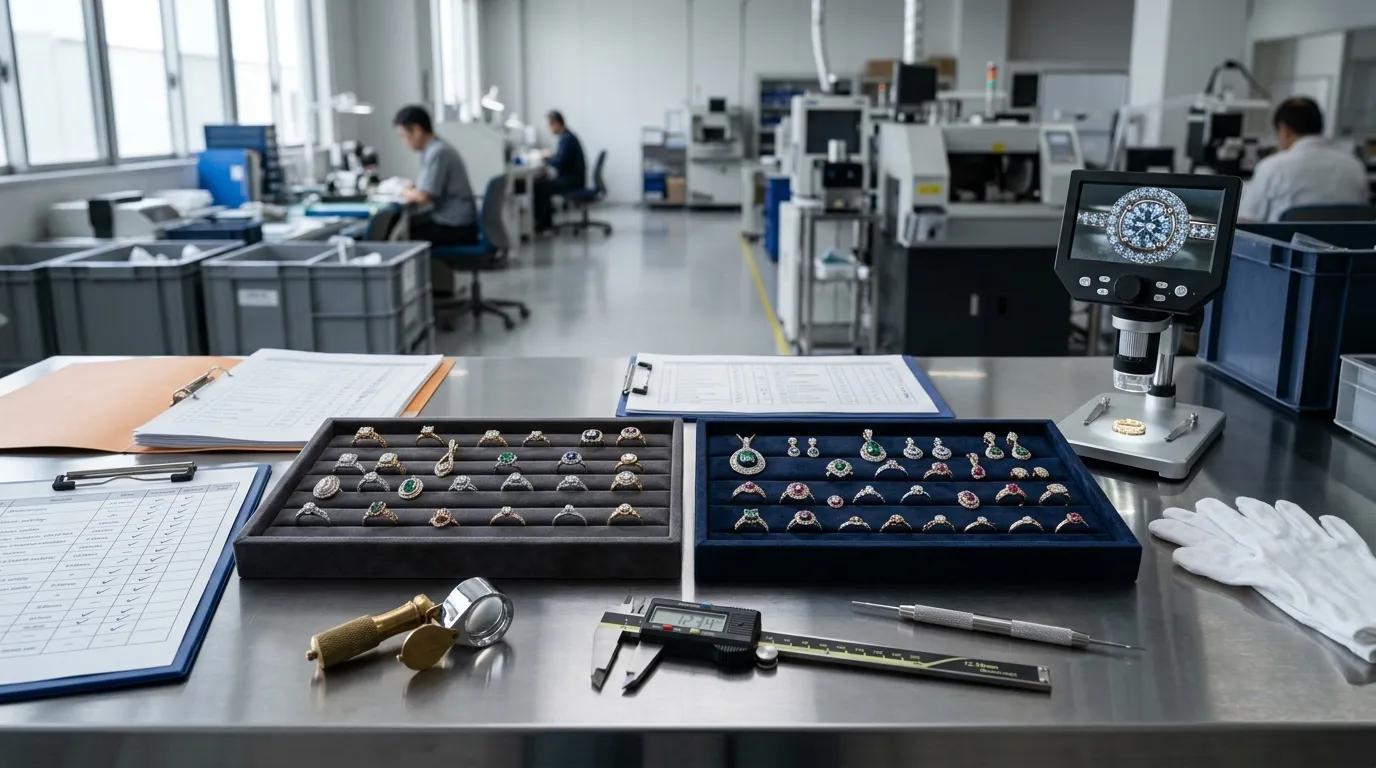
A jewelry QC checklist turns your product expectations into clear inspection requirements. It defines what to check, when to check it, acceptable results, and what happens when a check fails. For custom jewelry, key areas include materials, dimensions, workmanship, finishes, stone setting, assembly, and packaging.
At SSJew, our custom jewelry manufacturing and quality inspection work starts with a shared understanding of the approved design, materials, finish, and acceptance criteria. Build the checklist before bulk production.
1. Start With the Approved Product Specification
Collect the documents that define your product before listing inspection points. Your checklist should refer to a current, approved specification rather than relying on emails, verbal instructions, or a sample alone.
Include technical drawings or CAD files; an approved sample or reference photos; material and component specifications; stone details; finish and plating requirements; critical dimensions and tolerances; logo and assembly details; and packaging or labeling requirements.
A sample communicates appearance, but may not define every measurable or hidden requirement. Use drawings for dimensions and written criteria for acceptable finish variation.
Record the specification version and approval date. When the design changes, ensure both sides use the same revision.
2. Organize the Checklist by Quality Category
Tailor the checklist to your design. Mark each item as applicable, not applicable, or pending confirmation.
Materials and components
Check whether materials and components match the purchase specification. Depending on the product, this may include metal, chain, clasp, posts, jump rings, stones, and other findings. Require approval before any substitution.
Visual appearance alone does not prove material composition. If your order requires a particular alloy, material declaration, or test, define the requirement and agree on the supporting evidence before production.
Dimensions and construction
List critical measurements such as ring size, pendant dimensions, chain length, thickness, or logo position. Record the target value and acceptable tolerance for each measurement that affects fit, function, appearance, or assembly.
Weight can be useful, but cannot replace dimensional or structural checks: a piece may meet its target weight and still have a weak connection or incorrect profile.
Workmanship and surface quality
List relevant defects, such as scratches, dents, pits, casting marks, rough edges, uneven polishing, visible seams, and inconsistent texture. Define viewing conditions when they affect consistency.
Avoid vague requirements such as “perfect finish.” Use the approved sample, reference images, and agreed defect criteria. Distinguish between visible areas and less visible areas only when your specification clearly defines that difference.
Plating and color consistency
For plated jewelry, check the specified finish and color, coverage of visible surfaces, and consistency across pieces in the order. Depending on the design, inspect recesses, edges, joints, and areas that are difficult to reach during finishing.
Color can vary under different lighting, so agree on the reference and viewing conditions. If thickness, adhesion, or wear testing matters, define the method and acceptance criteria; appearance alone cannot verify these properties.
Stone setting and assembly
For stone-set jewelry, check stone type, placement, alignment, visible damage, and setting security. Inspect prongs or bezels for gaps, deformation, or sharp edges where relevant. Match assembly checks to function: clasps should work, links should articulate, and moving parts should not bind. Define how functional results are recorded.
3. Check Quality at the Right Production Stages
Final inspection matters, but it cannot efficiently replace every earlier check. Some defects are easier to identify or correct before the next process makes them harder to access.
Production stage
Useful QC focus
Why it matters
Incoming materials and components
Material identity, component specifications, visible damage
Prevents incorrect inputs entering production
CAD, prototype, or sample approval
Design, dimensions, stone layout, finish expectations
Resolves misunderstandings before bulk work
Casting, stamping, or CNC
Shape, dimensions, visible process defects
Finds issues before finishing
Polishing and surface preparation
Scratches, rough edges, surface uniformity
Helps prevent defects from carrying forward
Electroplating or other finishing
Color, coverage, agreed finish checks
Makes finish requirements part of process control
Stone setting and assembly
Stone security, alignment, connections, function
Targets risks introduced during assembly
Final inspection and packing
Overall conformity, quantity, packaging, labels
Confirms the shipment matches the order
Treat this as a starting framework, not a universal process map. Choose checkpoints according to the design, material, production route, and agreed requirements.
For higher-risk features, check them before the next production stage where practical. Finding an incorrect stone layout before setting, for example, may avoid later rework. A surface defect found before plating may also be easier to address than one found after finishing.
4. Define Pass, Fail, and Defect Severity
A checklist is incomplete if it names an inspection item but does not explain how to judge the result. For each critical characteristic, define the requirement, inspection method, acceptance criteria, and record to keep.
A practical classification may include:
-
Critical: A condition that creates a safety or legal compliance concern, or makes the product unsuitable under your defined requirements.
-
Major: A defect that materially affects function, structural integrity, specification conformity, or expected appearance.
-
Minor: A limited deviation that does not materially affect function or core conformity but falls outside the agreed appearance standard.
These are examples, not a universal standard. Define each category with product-specific examples.
If you use acceptance quality limits (AQL) or another sampling plan, document the standard, inspection level, sample size, acceptance and rejection numbers, and defect classifications. Writing only “AQL applies” is not enough. Sampling does not guarantee that every piece is defect-free, and critical features may need additional controls.
5. Keep Inspection Records and Define Corrective Actions
Inspection records should support a decision. Depending on the order, record:
-
Order or batch reference and specification version.
-
Inspection date, stage, and responsible person.
-
Sample size and selection method, if sampling is used.
-
Results for critical checks, including measurements where relevant.
-
Photographs of defects and any approved deviation.
-
Corrective action, reinspection result, and final disposition.
Agree how to handle failures: separate affected pieces, investigate, correct, and reinspect. Define who can approve a deviation and whether written approval is required before shipment.
Corrective action should address causes, not only symptoms. Repeated scratches may prompt a review of handling or finishing; inconsistent plating color may require checking the reference and finishing controls. These are investigation paths, not assumptions.
Record whether an exception applies only to one batch or changes future specifications.
6. Adapt the Checklist to Product Risk
Use a short checklist for simple designs and separate records for complex stone-set pieces. Prioritize features by failure impact, inspection difficulty, and process risk.
For example, a polished pendant may need checks for dimensions, finish, edges, plating, and logo placement; a multi-stone ring may need checks for stone identity, setting security, size, and symmetry. A chain may need length, link, clasp, and connection checks.
Separate checks required on every piece from those covered by sampling. For critical safety, compliance, or functional features, decide whether sampling is appropriate based on risk and applicable requirements.
7. Common Mistakes to Avoid
Subjective language: Replace “good” or “premium” with observable criteria and approved references.
Final inspection only: Add earlier checks where they can prevent rework or identify the source of defects.
Undefined tolerances: Agree on measurement methods and acceptable ranges for critical dimensions or other variables.
Relying on the sample alone: Document hidden details, materials, tolerances, packaging, and function separately.
Informal changes: Record revisions and retire obsolete instructions.
Unclear rejection process: Define how nonconforming pieces are corrected, reinspected, and approved.
8. FAQ: Jewelry QC Checklists
When should you send the checklist to your manufacturer?
Share a draft during quotation or sampling, then finalize it with the approved specification before bulk production.
Should every jewelry product use the same checklist?
No. Keep a common structure, but tailor checks to each product's materials, construction, finish, function, and risks.
Is final inspection enough?
Not always. Final inspection assesses finished pieces, while earlier checks can identify issues before more processing or assembly increases rework. The right stages depend on the product and production route.
Does AQL guarantee zero defects?
No. AQL is a sampling approach, not a guarantee that every unit is defect-free. Define the plan, defect classes, acceptance rules, and any additional controls.
Conclusion: Make QC a Shared Production Standard
A strong jewelry QC checklist connects your approved sample and written specification to checks throughout production. It identifies the materials, dimensions, finishes, construction details, and functions that matter; defines acceptance criteria; and records how failures are handled.
When you discuss a custom jewelry project with SSJew, share your drawings, approved references, material and finish requirements, critical tolerances, and packaging specifications. We can review the manufacturing requirements relevant to your project and help clarify the inspection points that need to be agreed before bulk production. If a specific test, tolerance, sampling plan, or production control is required, confirm its method and responsibility in writing rather than assuming it is included.
The goal is not to make the checklist as long as possible. It is to make every important requirement clear enough for you and your manufacturer to apply consistently.