Jewelry Quality Inspection Checklist for B2B Buyers
Jewelry Quality Inspection Checklist for B2B Buyers
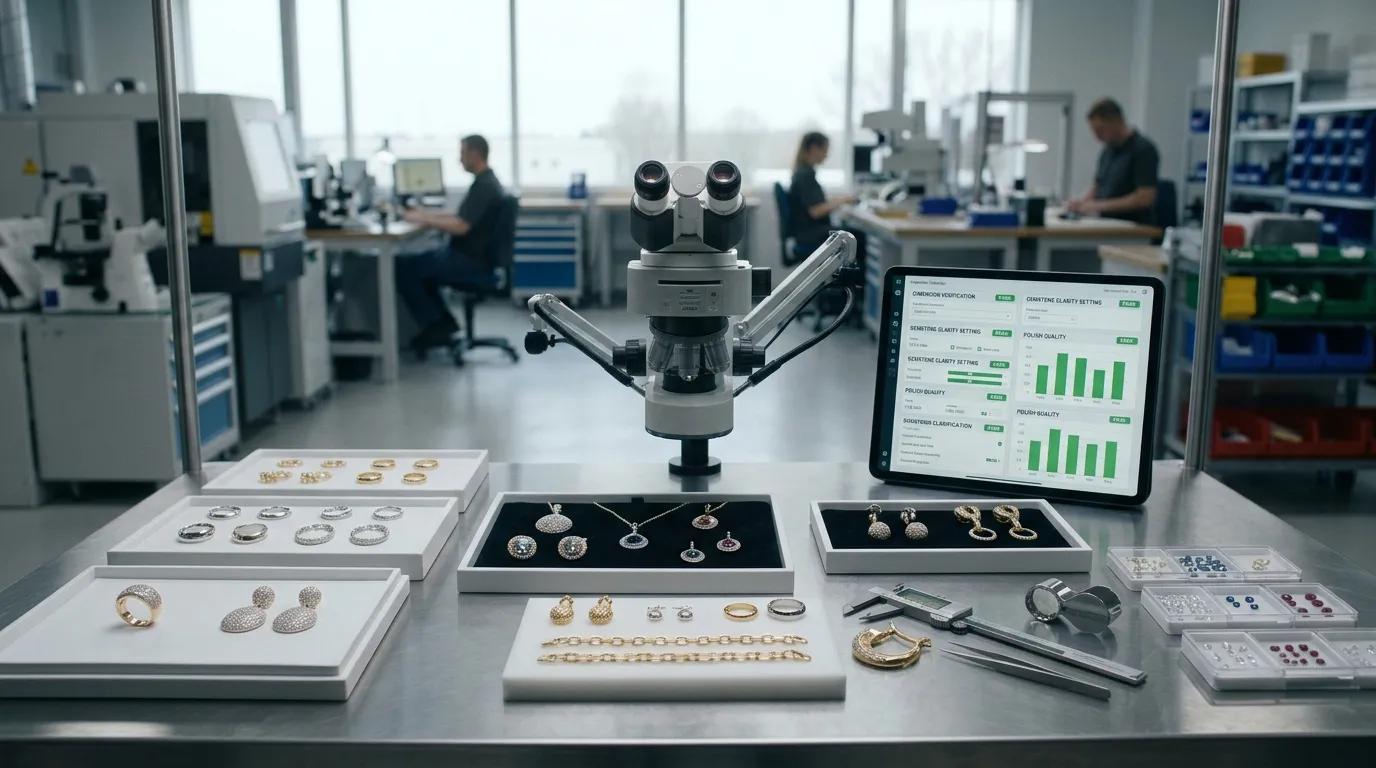
When you source jewelry for a brand, retail business, or wholesale collection, a product that looks good in a photograph is not enough. You need to know whether the finished pieces match your approved sample, written specifications, material requirements, and agreed quality standards.
A jewelry quality inspection checklist helps you turn these expectations into repeatable checks. It can also reduce disagreements about defects, rework, delivery approval, and responsibility after shipment.
At SSJew, we understand that quality requirements depend on the product design, materials, construction, and finishing processes involved. A stone-set ring, a fine chain, and a plated brass pendant do not have identical inspection needs. Your checklist should therefore combine common quality checks with product-specific requirements.
What Should a Jewelry Quality Inspection Checklist Cover?
Before production begins, document the approved specifications and decide how each requirement will be verified. Use the following checklist as a starting point, then adapt it to your product.
1. Product Specifications and Approved Samples
-
Confirm the product code, design version, quantity, and order details.
-
Compare the finished piece with the approved sample, drawings, and product specifications.
-
Check the shape, proportions, thickness, component placement, and overall appearance.
-
Verify any agreed dimensions and tolerances.
-
Confirm that all approved design changes have been recorded.
Do not rely on a sample alone when important details are difficult to judge visually. Record measurable requirements, such as ring size, chain length, pendant dimensions, or component thickness, in the specification sheet.
The approved sample should represent the intended product, but it should not replace written requirements. If a sample and a drawing appear inconsistent, resolve the difference before bulk production rather than allowing each party to interpret it differently.
2. Materials and Components
-
Verify the specified base material and alloy or material grade, where applicable.
-
Confirm that the components used match the approved bill of materials.
-
Check findings, clasps, posts, jump rings, chains, and other functional components.
-
Confirm required metal stamps, trademarks, or hallmarks where applicable.
-
Review any required material documentation or test results.
A visual inspection cannot reliably confirm every material property. If your order requires a particular metal composition, precious-metal fineness, restricted-substance compliance, or other regulated property, agree on the appropriate verification method and supporting documentation.
For example, a piece that resembles sterling silver is not necessarily proven to meet your specified silver standard. The inspection plan should identify which requirements can be checked visually and which need documentation or testing.
3. Dimensions, Structure, and Function
-
Measure the dimensions specified in the product drawing or inspection sheet.
-
Check symmetry, alignment, thickness, and component positioning.
-
Inspect soldered or joined areas for visible gaps, rough connections, or other unacceptable workmanship.
-
Open and close clasps and other moving components repeatedly.
-
Check that chains, links, hinges, and closures move as intended.
-
Look for sharp edges, burrs, or exposed points that could create a handling risk.
Functional checks should reflect how the product is designed to be used. A clasp should close securely and operate properly; a hinged component should move as intended without obvious binding. If you require a specific force, cycle count, or performance threshold, define the test method and acceptance limit before inspection.
Do not treat a quick hand check as proof of long-term durability. It can identify obvious problems, but it does not replace a defined mechanical test where one is required.
4. Surface Finish, Plating, and Color
-
Inspect for scratches, dents, pits, polishing marks, stains, and visible contamination.
-
Check whether the finish is consistent across comparable surfaces and pieces.
-
Compare plating or PVD color with the approved reference under consistent lighting.
-
Look for visible peeling, blistering, exposed base metal, or uneven coating coverage.
-
Check edges, recesses, joints, and detailed areas where finishing may be difficult.
-
Confirm that the required finish—such as polished, matte, brushed, or textured—matches the specification.
Surface quality depends on more than the final coating. Casting or forming defects may remain visible if surface preparation and polishing do not correct them. Similarly, uneven color may relate to surface preparation, coating conditions, geometry, or differences between production batches.
A visual check can identify visible defects and color differences, but it cannot confirm plating thickness, adhesion performance, or wear resistance by itself. If these properties are important to your product, specify the required test method and acceptance criteria separately.
5. Stones, Settings, and Decorative Details
-
Confirm stone type, color, shape, size, quantity, and placement against the approved specification.
-
Check for missing, chipped, visibly damaged, or mismatched stones.
-
Inspect prongs, bezels, channels, and other setting structures for visible irregularities.
-
Look for uneven stone alignment, exposed gaps, or settings that appear incomplete.
-
Check whether decorative components are secure according to the agreed inspection method.
-
Compare the overall appearance and layout with the approved sample.
Pay particular attention to stone-set products during sample approval and bulk inspection. Small differences in stone dimensions, setting geometry, or alignment can affect both appearance and security.
A stone that appears correctly positioned may still require a separate security test. Define the appropriate method for the product and stone-setting design rather than assuming that visual inspection alone establishes setting strength.
6. Markings, Packaging, and Order Requirements
-
Verify logos, stamps, engraving, labels, and other approved markings.
-
Check that each product is packed using the agreed packaging materials and method.
-
Confirm SKU labels, quantities, and product identification.
-
Inspect protective packaging for suitability during handling and transport.
-
Verify that the shipment quantity and product assortment match the order.
-
Check any required documents, care instructions, or inserts.
Packaging is part of order quality, not an unrelated final task. Incorrect labels, mixed SKUs, missing components, or inadequate protection can create problems even when the jewelry itself passes inspection.
How to Inspect Jewelry at Each Production Stage
A final inspection is important, but it is not the only opportunity to identify problems. Use checks at several stages so that defects can be addressed before they affect the entire order.
Stage 1: Sample approval. Confirm the design, dimensions, materials, color, surface finish, stone placement, functional details, and packaging requirements. Record the approved version and any agreed deviations. This creates a reference for bulk production.
Stage 2: In-process inspection. Focus on the operations most likely to affect the product. Depending on the design, this may include casting quality, stamping accuracy, CNC dimensions, polishing, stone setting, assembly, or surface treatment. Identifying a recurring defect during production may prevent the same issue from appearing across a larger quantity.
Stage 3: Pre-shipment inspection. Check finished products against the approved specifications and agreed acceptance criteria. Include appearance, dimensions, function, components, markings, packaging, and quantity as applicable. Record findings and agree on how any nonconforming items will be handled before shipment approval.
The exact inspection frequency depends on product complexity, order size, production risk, and the quality agreement. Do not assume that every order needs the same inspection plan.
How to Classify Defects and Set Acceptance Criteria
A checklist becomes much more useful when you define what happens if an item fails. Agree on defect categories and acceptance rules before production begins.
Defect category
Typical examples
Recommended approach
Critical
A defect that creates a serious safety or legal compliance risk
Define the applicable requirements and escalation procedure before production
Major
A defect that affects function, material conformity, structural integrity, or a key product requirement
Define clear rejection or corrective-action criteria
Minor
A limited cosmetic issue that does not affect function but falls outside the agreed appearance standard
Set visual references and acceptable limits in advance
These examples are a framework, not a universal classification. Your product specification and applicable requirements determine how each defect should be categorized. A cosmetic mark that is acceptable on one product may be unacceptable on a premium polished surface.
You should also agree on the inspection method. For larger orders, an agreed sampling plan may be more practical than checking every item, but sampling does not guarantee that all pieces are defect-free. Specify the sample size, selection method, defect categories, and acceptance numbers. If you use an AQL-based plan, define the applicable standard and inspection level rather than writing “AQL applies” without further detail.
For high-risk characteristics, you may need additional controls beyond a general visual sampling plan. Material verification, specific functional tests, or other checks may be necessary depending on the product and its intended market.
Common Jewelry Inspection Mistakes
Approving a sample without documenting its details. If color, dimensions, stone placement, or finish are not recorded, disagreements can arise when bulk production differs from what you remember approving.
Checking only the front of the product. Backs, edges, joints, clasps, recessed areas, and contact points may reveal problems that are not visible from the front.
Treating appearance as proof of performance. A polished surface does not prove material composition, coating thickness, adhesion, or stone security. Match each requirement to an appropriate verification method.
Using vague standards such as “good quality.” Replace subjective wording with measurements, reference images, defect examples, and written acceptance criteria wherever possible.
Waiting until shipment to identify recurring defects. Final inspection can identify nonconforming products, but it may be too late to correct a process problem efficiently. Include suitable checks during production.
Changing specifications without controlling revisions. If a design or finish changes after sample approval, record the change and confirm which version applies to the order.
Questions to Ask Your Jewelry Manufacturer
Before placing a production order, ask your manufacturing partner:
-
How do you record and confirm the specifications of an approved sample?
-
Which quality checks are performed during production, and which take place before shipment?
-
How do you verify material requirements and special customer specifications?
-
How are cosmetic, dimensional, and functional defects recorded and classified?
-
What inspection method, sampling plan, and acceptance criteria will apply to this order?
-
How are nonconforming products handled, and how will corrective actions be communicated?
-
How do you control changes so that bulk production remains consistent with the approved version?
The value of these questions is not simply whether a supplier answers “yes.” You need a clear explanation of the process, the applicable checks, the records available, and the responsibilities agreed for your order.
At SSJew, our custom jewelry manufacturing process can involve CAD, prototyping, sampling, casting, stamping, CNC, polishing, stone setting, surface finishing, assembly, and quality inspection, depending on your design and agreed scope. When you discuss a project with us, provide your drawings or reference sample, material and finish requirements, key dimensions, and any special acceptance criteria. This helps us understand what your finished product needs to meet before production requirements are finalized.
FAQ
Should every jewelry piece be inspected?
Not necessarily using the same method. The appropriate approach depends on order size, product complexity, risk, customer requirements, and the agreed inspection plan. Some characteristics may require broader checks, while others can be assessed through an agreed sampling method.
Is visual inspection enough to approve jewelry quality?
No. Visual inspection is useful for identifying visible surface, assembly, and appearance problems, but it cannot verify every material property or performance characteristic. Use documentation or appropriate tests when the specification requires them.
What is AQL in jewelry inspection?
AQL, or Acceptance Quality Limit, is used within certain sampling inspection systems to establish acceptance criteria for a sample. It should be applied through a defined plan, including the relevant standard, inspection level, sample size, and acceptance numbers. It is not a guarantee that every item in a shipment is defect-free.
When should I approve the jewelry sample?
Approve the sample after checking it against the design, materials, dimensions, finish, functional requirements, and other critical specifications. Record the approved version and resolve discrepancies before authorizing bulk production.
What should I do if the shipment fails inspection?
Document the affected products, defect types, quantities, and supporting photographs or measurements. Compare the findings with the agreed acceptance criteria, then agree on the next action with your supplier. Depending on the issue and agreement, this may involve sorting, rework, replacement, further inspection, or a revised shipment decision.
Conclusion: Turn Your Checklist into a Quality Agreement
A jewelry quality inspection checklist is most effective when it is specific to your product and agreed with your manufacturer before production. Confirm the approved sample, define measurable requirements, identify product-specific risks, select suitable inspection methods, and establish how defects will be handled.
If you are developing a new collection or sourcing a repeat order, SSJew can discuss your design, material, finishing, sampling, and inspection requirements as part of a custom jewelry manufacturing project. Contact our team with your product specifications and quality expectations so we can assess the manufacturing requirements and clarify the next steps for your order.