
How Design Complexity Affects Custom Jewelry Pricing
How Design Complexity Affects Custom Jewelry Pricing
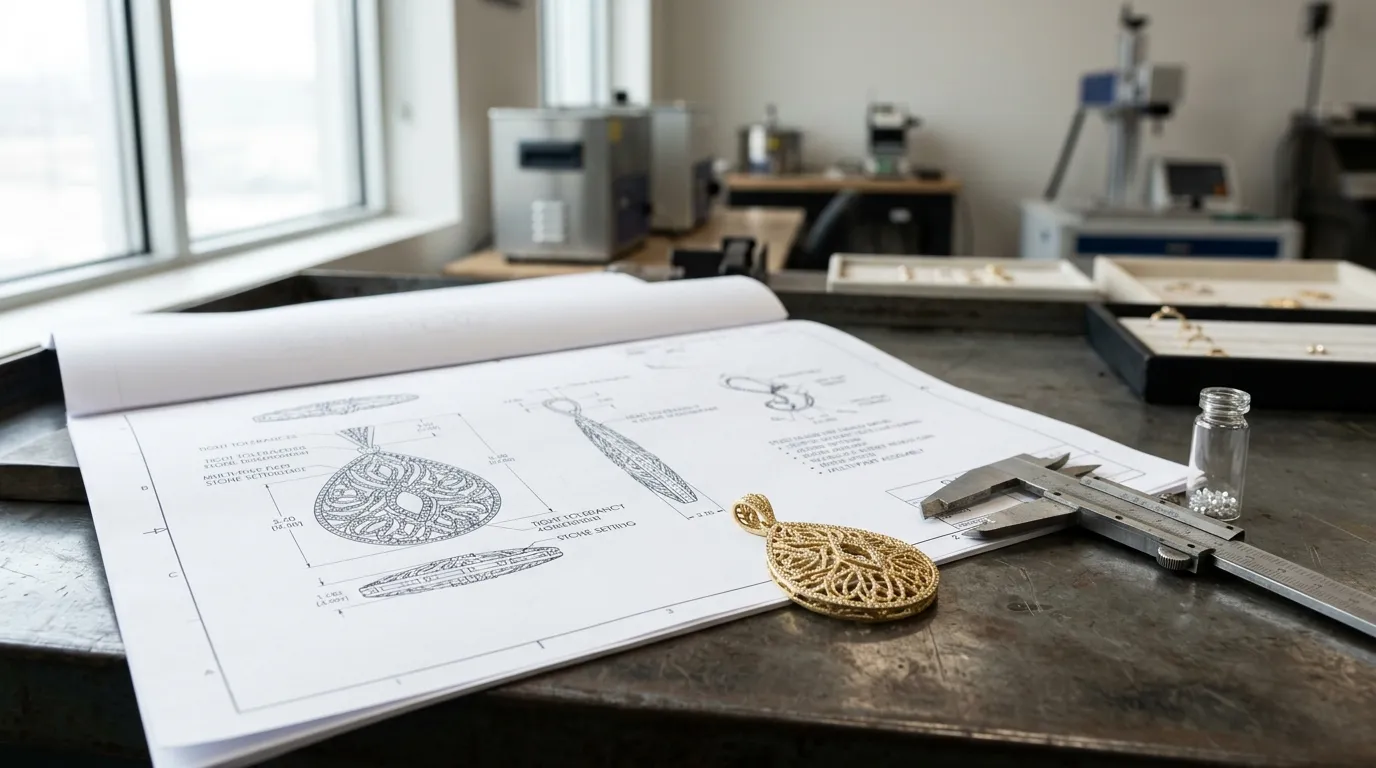
If you are developing custom jewelry for your brand, a design that looks only slightly more detailed can sometimes require a very different manufacturing process.
A complex design may need more CAD work, additional components, more stone-setting operations, tighter tolerances, extra polishing, more assembly and additional quality-control checkpoints.
At our SSJew, we evaluate design complexity from a manufacturing perspective. The goal is not simply to tell you that a design is expensive, but to identify which production requirements are creating the cost and where the design can be optimized before bulk production.
Why Does Design Complexity Affect Your Jewelry Cost?
A Complex Design Creates More Production Steps
Your jewelry does not move directly from a drawing to a finished product.
Depending on the design, the production route may include:
CAD → Sampling → Molding/Casting or CNC → Stone Setting → Polishing → Plating → Assembly → QC
Every additional operation can introduce labor, setup, material handling and inspection requirements.
For example, a simple pendant with a smooth surface may require relatively few production stages. A pendant with multiple components, recessed details, stones and different finishes requires considerably more coordination.
Public industry costing references commonly place labor at around 15–40% of unit cost, while finishing may represent roughly 5–20% and plating/coating around 10–35%, depending on the product and manufacturing route. These are indicative industry ranges, not SSJew pricing.
Visual Complexity and Manufacturing Complexity Are Different
This distinction matters when you are requesting a quotation.
A design can look complicated but still be relatively straightforward to manufacture if it uses repeatable geometry.
Another design may look simple but require difficult production control because of:
-
Very thin walls
-
Tight dimensional tolerances
-
Hidden joints
-
Moving parts
-
Difficult stone seats
-
Deep engraving
-
Multiple surface finishes
Therefore, you should ask your manufacturer to evaluate manufacturing complexity, not only visual appearance.
Which Design Elements Increase Custom Jewelry Pricing?
CAD and 3D Modeling
CAD is where your design becomes a production structure.
The CAD model may need to define wall thickness, stone seats, prongs, dimensions, connections and tolerances.
Public 2026 CAD pricing references range from approximately $50–$150 for simple designs, $150–$350 for moderate complexity, and $350–$800+ for highly complex work. Another published manufacturing source gives a broader reference of roughly $100–$600. Actual pricing varies by supplier, market and project scope.
At our SSJew, CAD is connected to manufacturability review, rather than being treated only as a visual rendering stage. Our CAD workflow checks structure, stone seats, wall thickness, tolerances and other production-sensitive details before sampling.
-
Average CAD Time for Simple Designs: 1–3 business days
-
Average CAD Time for Complex Designs: 3–7 business days
-
Average Revision Rounds: 1–2 rounds per design
Stone Count and Setting Complexity
Stone setting can significantly change the labor requirement.
A single large stone and a design containing dozens of small stones are not equivalent production jobs.
Your cost can increase with:
Stone count + setting type + stone size + positioning accuracy + accessibility
Pavé, channel, bezel and multi-prong settings each create different production requirements.
Our SSJew process includes stone setting and inspection for alignment, symmetry and setting security before the product moves to subsequent stages.
Multi-Part Construction and Moving Components
Bracelets, earrings and mechanical jewelry can contain multiple components, hinges, clasps or moving parts.
Each additional interface creates another point that must fit correctly.
A design with 10 separate components does not simply require more material than a one-piece design. It also requires additional assembly, alignment and inspection.
-
Average Assembly Time for Multi-Component Designs: 15–30 minutes per piece
-
Average Rework Rate: ≤2%
Surface Details, Engraving and Finishing
Fine textures, engraving, polishing requirements and multiple finishes can increase production time.
For plated jewelry, surface preparation becomes especially important because polishing defects or uneven surfaces can remain visible after plating.
Our SSJew production workflow connects polishing, surface refinement, plating and finish inspection instead of treating finishing as an isolated final step.
Tight Tolerances and Structural Requirements
Some designs require tighter control than others.
Thin sections, small stone seats, narrow gaps and functional components may need additional CAD review and sampling before production.
This is why a design that looks simple in a product image may still receive a higher manufacturing quotation.
How Should You Evaluate a Factory Quote?
Ask Which Production Steps Drive the Cost
Instead of asking only:
“Why is your price higher?”
Ask:
“Which part of the manufacturing process is driving the additional cost?”
Your manufacturer should be able to connect the quotation to actual production requirements.
For example:
More CAD → More development cost
More stones → More setting labor
More components → More assembly
More finishing requirements → More processing
Tighter tolerances → More manufacturing control
Separate Development Costs From Unit Costs
CAD, molds, prototypes and sampling are often development costs rather than recurring production costs.
You should ask your factory to separate:
One-Time Development Cost
from
Recurring Cost Per Piece
This makes your future reorder economics much easier to understand.
How Can You Reduce Design-Related Manufacturing Risk?
Validate Complex Details With CAD and Sampling
Do not wait until bulk production to discover that a detail is too thin, a stone seat is difficult to produce or two components do not align.
Our SSJew process uses CAD → physical sampling → approval → bulk production, allowing design problems to be identified earlier.
Our current manufacturing system also reports 200+ active craftsmen and monthly capacity exceeding 500,000 pieces, supporting larger B2B production programs.
Lock the Approved Sample Before Bulk Production
Once your sample is approved, it should become the production reference.
Our SSJew QC workflow checks materials, workmanship, plating, stone setting, dimensions and packing against the approved sample, with incoming, inline and final inspection stages.
-
Actual 100% Inspection Rate: 100% of finished pieces
-
Actual Defect / Rework Rate: ≤2%
-
Sample-to-Bulk Deviation Rate: ≤1%
How Do You Build Complex Jewelry for Repeat Orders?
Design for Manufacturability and Repeatability
Your goal should not be to remove every complex detail.
Instead, you should identify which details create meaningful product value and which create unnecessary manufacturing difficulty.
A good manufacturing partner can help you evaluate:
Design Value + Manufacturing Feasibility + Target Cost + Repeatability
At our SSJew, we connect CAD, sampling, casting/CNC, stone setting, polishing, plating and QC into one production workflow so your approved design can move toward repeatable manufacturing.
For your next custom jewelry project, send your sketch, reference image or CAD file with your target material and quantity. The more clearly your design requirements are defined, the more accurately the manufacturing route and quotation can be evaluated.