
How Jewelry Brands Manage Repeat Production
How Jewelry Brands Manage Repeat Production
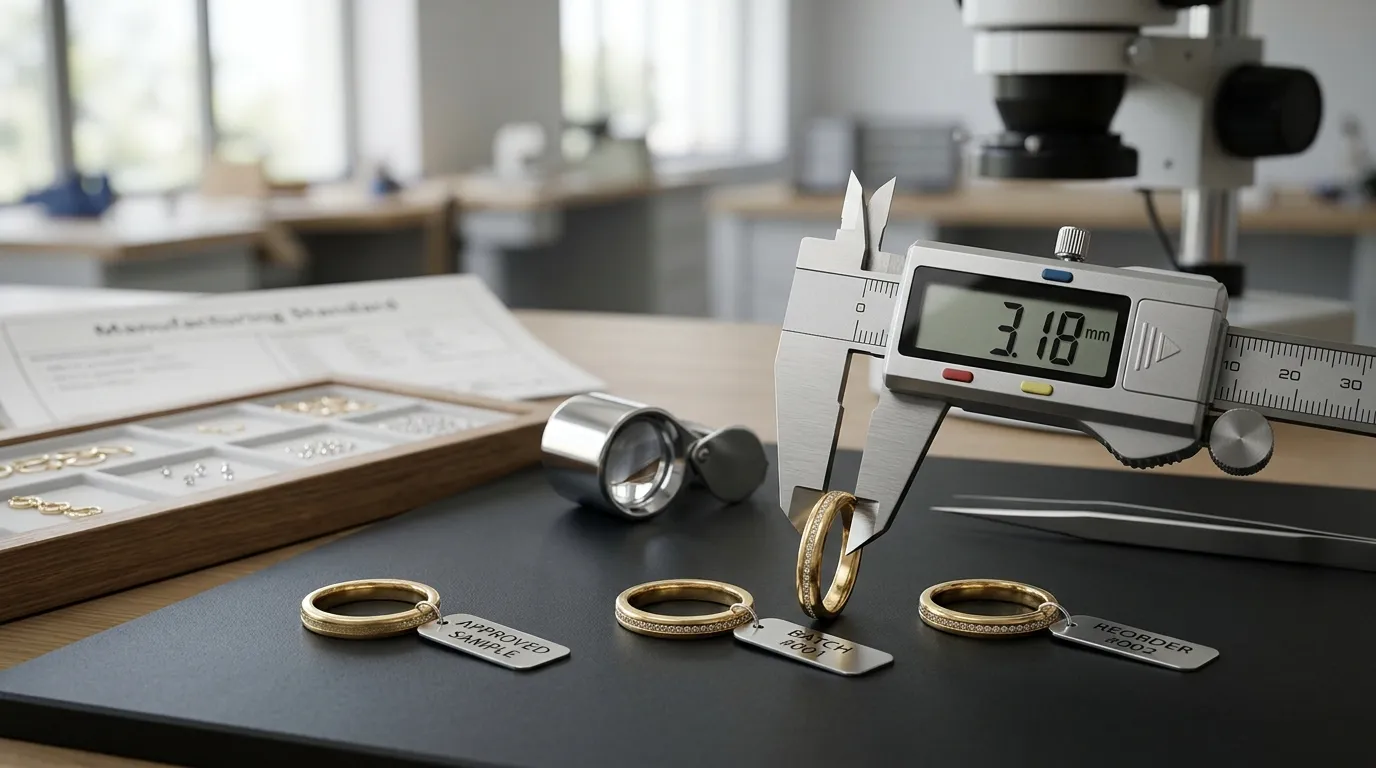
For a jewelry brand, the first production order is only one part of the manufacturing process. If a product sells well, you need to reproduce it again without changing the details that made the original product acceptable.
That is where repeat production becomes important.
Repeat jewelry production is not simply making the same design again. It means reproducing the same approved manufacturing standard across different production batches.
At SSJew, we approach repeat production around this principle. Your approved sample, production specifications, material choices, finishing requirements, and quality-control checkpoints need to stay connected from the first order to future reorders. Our manufacturing workflow covers CAD and sampling, material control, finishing, and final inspection to support consistency from sample to bulk and into repeat production.
Why Repeat Jewelry Production Is More Difficult Than It Looks
A jewelry product can look simple while containing many production variables.
A small change in base material, dimensions, weight, polishing, plating, stone positioning, or assembly can make the finished piece look or perform differently.
For example, if you reorder a gold-tone necklace, the product name alone does not tell the factory everything needed to reproduce it. You may also need to control:
-
Base material
-
Product dimensions
-
Target weight
-
Surface preparation
-
Polishing direction
-
Plating color
-
Plating specification
-
Stone type and setting position
-
Components and assembly
-
Logo details
-
Packaging requirements
-
QC requirements
This is why a previous purchase order or product photograph is usually not enough to function as a complete manufacturing reference.
Your goal should be to make the approved product repeatable, not simply recognizable.
Start With an Approved Sample, Not Just a Product Photo
The approved sample should become one of the most important references in your repeat production process.
Before bulk manufacturing, you need to confirm that the physical sample represents what you actually want to sell. This is where you can review dimensions, proportions, surface appearance, stone placement, construction, comfort, and finish before production is scaled.
At SSJew, we use sampling to validate the physical product before bulk production. Once a sample is approved, it provides a clearer reference for production and QC rather than leaving expectations only in emails, images, or conversations.
The important point is that sample approval should not end when the first order ships.
If you expect to reorder the product six months later, the same approved reference should still help your team and the manufacturer understand what needs to be reproduced.
What Should Be Carried From the First Order to the Next?
A repeat order becomes easier to control when the original production standard is clearly defined.
1. Material
Record the actual material route used for the approved product.
For example, a design may be developed in 925 sterling silver, brass, or gold, and the material decision affects manufacturing, finishing, cost, and product positioning.
If you change the material during a reorder, you should not assume the finished appearance will remain identical.
We recommend keeping material decisions connected to the approved sample and production specification. Our materials and finishes workflow is designed around aligning material and finish targets before sampling, approving one working sample, carrying the standard into production, and using the same reference logic for future reorders.
2. Dimensions and Weight
Dimensions and weight can influence both appearance and manufacturing consistency.
For a repeat order, you should know which measurements are critical to the product. These may include:
-
Overall length
-
Width and thickness
-
Stone size and position
-
Chain or component dimensions
-
Ring size
-
Target weight
-
Connection points
Not every dimension requires the same tolerance, but important dimensions should be defined before production.
3. Surface Finish
Polishing and surface preparation can significantly affect how a jewelry piece looks under retail lighting.
A mirror polish, brushed surface, matte finish, textured surface, or combination finish requires different production handling.
If your first sample has a particular surface appearance, the manufacturer needs a clear reference for reproducing it.
4. Plating and Color
Plating is one of the areas where repeat production can become visibly inconsistent.
A product described only as “gold plated” does not fully define its manufacturing specification.
You may need to control the plating route, color reference, surface preparation, and other agreed specifications depending on the product.
At SSJew, our in-house plating workflow is integrated with production so finish direction and color consistency can be controlled as part of the manufacturing process rather than treated as an isolated final step.
5. Stone Setting and Assembly
Stone-setting accuracy is especially important for products with multiple stones or detailed layouts.
Your approved sample should establish the expected stone position, alignment, spacing, and visual balance.
During repeat production, these details should be checked during production rather than discovered only after the entire batch is finished.
Our QC workflow includes in-line checks during processes such as casting, polishing, plating, and stone setting, allowing issues to be identified before they move through the next production stage.
6. Packaging and Branding
Repeat production does not stop with the jewelry itself.
If your product uses branded boxes, pouches, cards, labels, inserts, or other packaging, those specifications should also be carried into the reorder process.
For private-label programs, stabilizing the product standard before expanding into logos and packaging can also reduce unnecessary revisions.
How Manufacturers Control Repeat Production
A repeatable product needs more than a good sample. It needs a manufacturing process that can use that sample as an operational reference.
The process can include several stages.
CAD and Production Files
Your approved design should be translated into production-ready information.
CAD helps define structure and dimensions before physical production. This creates a more useful reference than relying only on a product photograph.
Sampling
The physical sample confirms whether the design works outside the screen.
At this stage, you can review appearance, dimensions, structure, finishing, stone placement, and other product-specific requirements.
Material Control
The material used in the approved product should remain aligned with the production specification.
Changing material without reviewing the consequences can create differences in weight, appearance, finishing, or cost.
In-Process Quality Control
Quality control should not happen only at the end.
At SSJew, our QC workflow includes incoming material checks, in-line production checks, and final release checks. Bulk output can be compared with the approved sample for areas such as color, dimensions, finishing, stone setting, and packing.
Final Inspection
Before shipment, the finished jewelry needs to be checked against the agreed requirements.
This provides a final opportunity to identify visible differences, dimensional issues, setting problems, finishing problems, or packing errors before the products reach your warehouse.
How We Approach Repeat Production at SSJew
At SSJew, we treat repeat production as an extension of the original product-development process.
We start with your design and translate it into production-ready information through CAD and sampling. After approval, the sample becomes a reference for production and inspection.
Our manufacturing workflow covers casting or other forming routes, stone setting, polishing, plating, assembly, and quality inspection. The objective is not simply to complete one production order, but to build a clearer production standard that can be used when your product moves into future orders.
For material-specific projects, we also connect material and finish decisions to the approved sample. This is particularly relevant when your collection contains multiple products that need to maintain a consistent visual direction.
Repeat Production Checklist for Jewelry Brands
Before placing a reorder, you can confirm the following with your manufacturing team:
Area
What to Confirm
Design
Approved CAD or production drawing
Sample
Which physical sample is the current reference?
Material
Exact material and material specification
Dimensions
Critical dimensions and tolerances
Weight
Target or reference weight where relevant
Finish
Polish, texture, matte or other surface requirements
Plating
Color, plating route and agreed specification
Stones
Type, size, position and setting requirements
Assembly
Clasps, links, joints and functional components
Branding
Logo and marking requirements
Packaging
Box, pouch, label and packing instructions
QC
Inspection points and acceptance requirements
Records
Previous production notes and approved revisions
This checklist also gives you a useful way to evaluate a supplier.
If a manufacturer cannot clearly explain how your approved sample, production specifications and QC requirements will be carried into the next order, you may have a consistency risk even if the first order looked good.
Common Mistakes That Cause Reorder Differences
Reordering From a Product Photo
A photo shows appearance but cannot fully describe material, dimensions, weight, plating, tolerances, or construction.
Changing Specifications Without Updating the Reference
If you change the material, plating, dimensions, or stone configuration, the old sample may no longer represent the new product.
Treating QC as a Final Inspection Only
If a problem is created during casting, polishing, plating, or setting, discovering it at final inspection can mean that the issue has already affected a large part of the batch.
Assuming the Second Order Is Automatically Identical
A repeat order still needs a clear production reference.
The manufacturer should know which sample and specifications are current rather than relying on memory or an old purchase order.