How Jewelry Brands Scale From Small Batches to Larger Orders
How Jewelry Brands Scale From Small Batches to Larger Orders
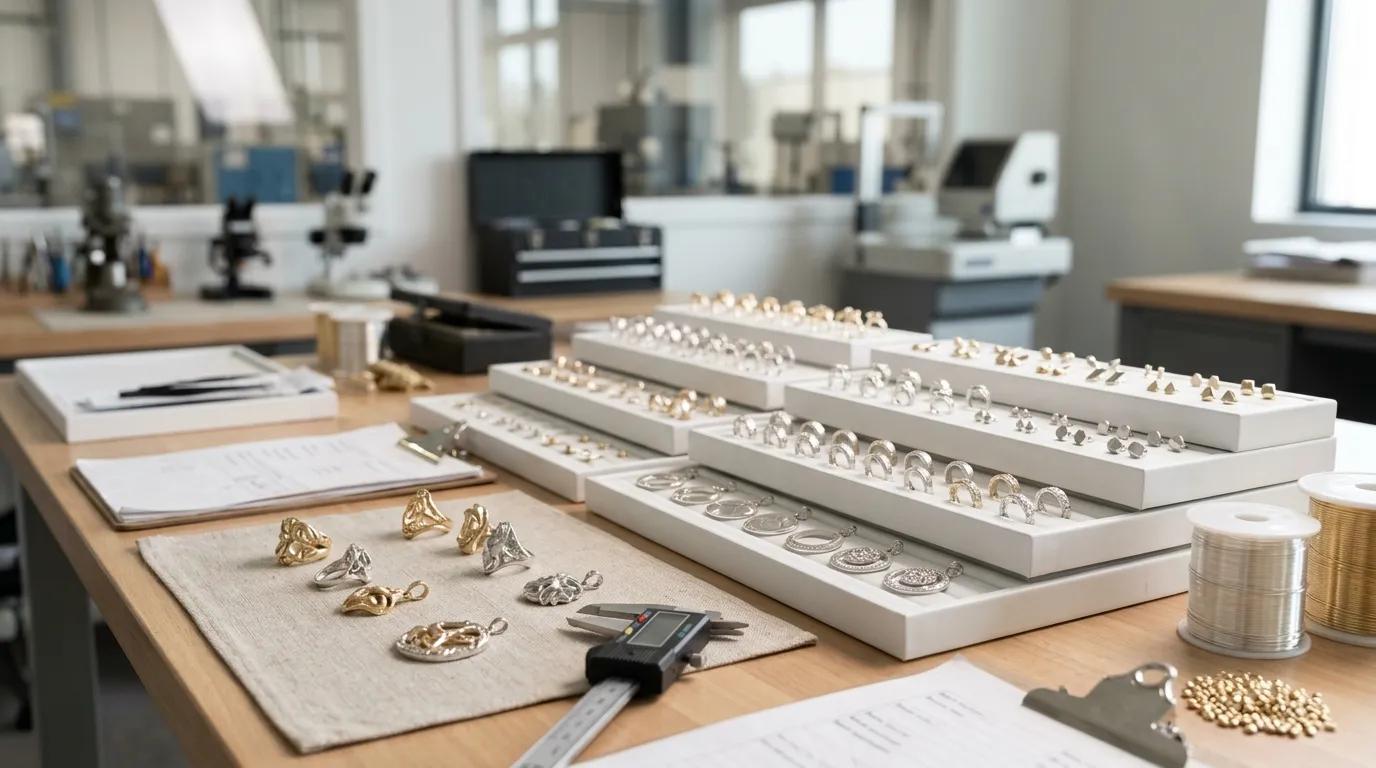
Moving from small-batch jewelry production to larger orders is an important step for a growing brand. However, increasing order quantities before your product, supplier, and inventory plan are ready can create problems with quality, delivery, and cash flow.
The goal is not simply to manufacture more pieces at a lower unit cost. You need to increase production while keeping specifications consistent, meeting customer demand, and maintaining enough flexibility to respond to changes in your market.
At SSJew, our custom jewelry manufacturing capabilities include CAD, prototyping, sampling, materials, surface finishing, and quality inspection. When planning a larger production run, these areas need to align with your product requirements and the manufacturing arrangements agreed for your project.
1. Know When Your Jewelry Brand Is Ready to Scale
Strong sales can indicate that a product deserves a larger order, but one successful launch does not always justify a substantial increase in production.
Before expanding, review your sales history, repeat-purchase patterns, inventory levels, and expected demand. Consider whether sales are consistent across several periods or driven by a temporary promotion, seasonal event, or unusually large customer order.
You should also evaluate your operational readiness. Have you finalized the design? Are the materials and finishes confirmed? Do you understand your actual production costs and expected replenishment schedule?
A useful distinction is between market validation and production validation. Market validation shows that customers want your product. Production validation gives you confidence that the product can be manufactured repeatedly to the agreed specifications.
If you have only completed a small initial order, use the next order to address any unresolved production issues before making a much larger commitment.
2. Expand Your Best-Performing SKUs First
When your collection contains multiple designs, scaling every product at the same time can tie up capital and complicate production planning.
Start by identifying the SKUs with the strongest evidence of sustained demand. Consider sales consistency, gross margin, return rates, current inventory, and the time needed to replenish each product.
For example, if two necklace designs sell at similar rates but one requires a complex stone-setting process and longer material preparation, they may need different production plans. Sales performance matters, but manufacturing requirements also affect how quickly you can replenish stock.
A practical approach is to group your products into three categories:
-
Core SKUs: Products with established demand and relatively predictable replenishment needs.
-
Growth SKUs: Products showing promising demand but with less historical evidence.
-
Experimental SKUs: New designs that still require market testing.
Prioritize core SKUs for larger orders where the evidence supports expansion. Keep growth and experimental products in more flexible quantities until demand becomes clearer.
This does not mean discontinuing new designs. It means avoiding the assumption that every product deserves the same inventory investment.
3. Prepare Your Product for Larger Production Runs
A design that works for a small batch may still need further preparation before larger-scale production.
Begin by confirming the final CAD files or technical drawings, material specifications, critical dimensions, stone details, assembly requirements, and surface finishes. Make sure the approved information reflects the version you intend to reorder.
Small changes can have broader effects than expected. Increasing pendant thickness may affect material consumption and weight. Changing a stone size may require adjustments to the setting. Switching from one base material to another may change the finishing process and the way the final product is evaluated.
Before expanding, confirm:
-
Which design files and specifications are approved.
-
Which materials, components, and finishes are required.
-
Which dimensions and appearance characteristics are critical.
-
Whether tooling, sampling, or additional validation is needed.
-
Which packaging and labeling requirements apply to each SKU.
Sampling is particularly important when a design has changed since the initial order. An approved sample should represent the intended product, while measurable requirements should remain documented separately where necessary.
At SSJew, we can discuss the applicable design development, sampling, and manufacturing requirements for your project. Confirm which steps are needed before increasing quantities rather than assuming that an earlier sample automatically covers every revision.
4. Evaluate Your Manufacturer's Production Readiness
Your manufacturer's ability to produce a sample or small order does not automatically establish its ability to deliver a much larger order within your required schedule.
Before increasing quantities, discuss the production plan with your supplier. Ask which stages are likely to determine the schedule and whether the proposed order requires additional coordination for materials, components, or specialized processes.
Jewelry manufacturing can involve several connected stages, including casting or stamping, CNC machining where applicable, polishing, stone setting, electroplating, assembly, and inspection. Not every product uses every process, and different designs can have different production bottlenecks.
For example, increasing the number of cast components may not increase total output proportionally if stone setting or finishing becomes the limiting stage. Similarly, several SKUs may share a material but require different finishing arrangements.
Ask your manufacturer:
-
What production quantity can be supported for this specific order?
-
Which materials or components need to be arranged in advance?
-
Which processes are likely to constrain the schedule?
-
When must design and sample approvals be completed?
-
How will changes or unexpected delays be communicated?
Request a schedule based on your actual product mix, quantities, and approval requirements. Avoid relying on a general lead-time estimate that does not account for your order's specific manufacturing needs.
5. Protect Quality as Order Quantities Increase
Larger production runs make consistent specifications and repeatable quality checks more important. A small variation that affects a few pieces in a pilot order may affect a much larger quantity when the same issue is repeated.
Start by identifying the characteristics that matter most to your product. Depending on the design, these may include dimensions, weight, stone placement, clasp function, polishing quality, plating appearance, or component assembly.
Separate your quality requirements into two groups:
Critical product requirements: Characteristics that must meet defined specifications, such as ring size, component dimensions, or stone-setting requirements.
Appearance and workmanship requirements: Characteristics assessed against agreed visual references or documented acceptance criteria, such as surface finish and color consistency.
Before bulk production, clarify which inspections will be performed, how defects will be classified, and what acceptance criteria apply. If you use an AQL-based sampling plan, specify the applicable inspection level and acceptance and rejection criteria. AQL is a sampling framework, not a guarantee that every unit is defect-free.
At SSJew, quali