
How to Compare Jewelry Manufacturer Quotes: A B2B Buyer’s Guide
How to Compare Jewelry Manufacturer Quotes: A B2B Buyer’s Guide
How to Compare Jewelry Manufacturer Quotes
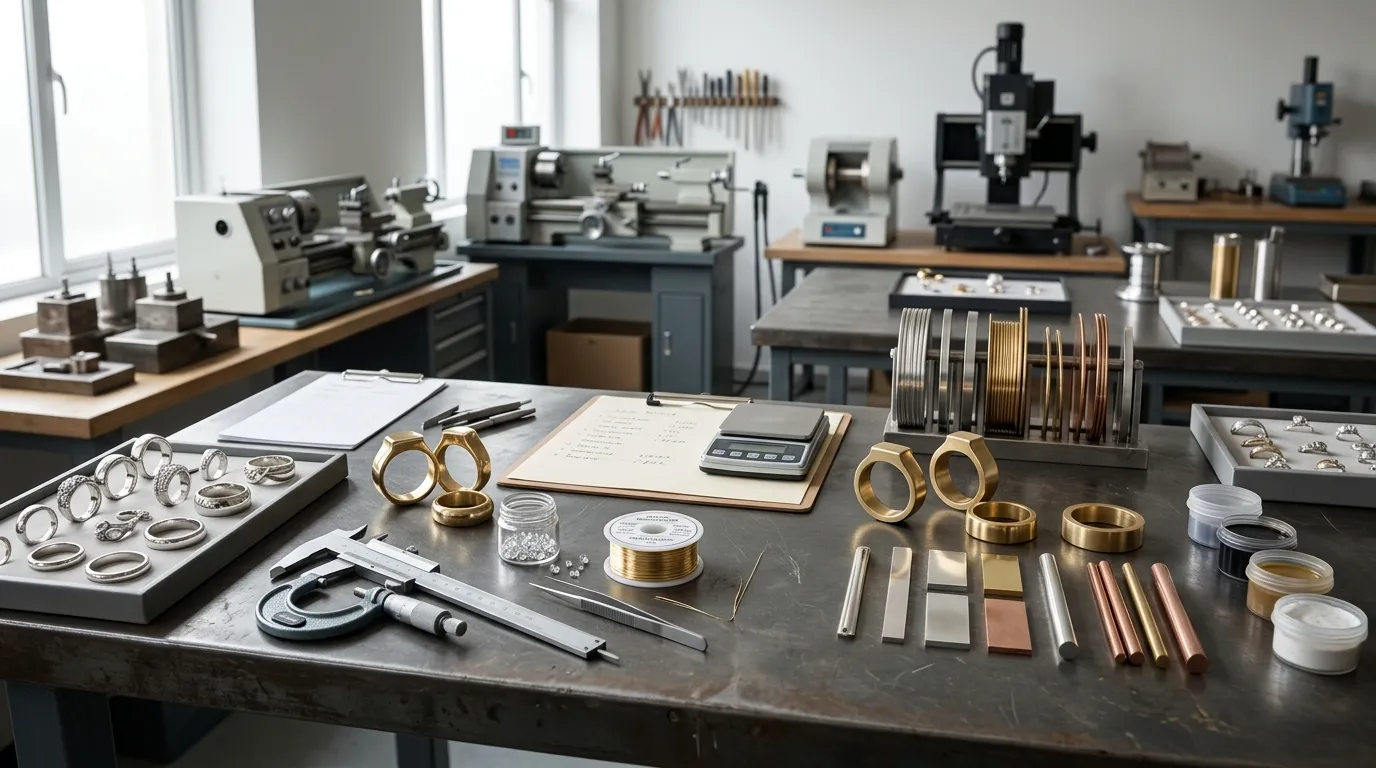
When you request quotations from several jewelry manufacturers, you may receive very different prices for what appears to be the same product.
A ring quoted at US$4.20 from one factory and US$3.60 from another is not necessarily a US$0.60 difference in manufacturing efficiency. The quotations may be based on different materials, plating specifications, quantities, tooling, packaging, or production assumptions.
For you as a jewelry buyer, the important question is not simply “Which factory is cheaper?”
It is:
“Are these quotations actually comparable?”
Why Do Jewelry Buyers Compare Manufacturers?
A Unit Price Does Not Tell the Full Cost
When you source custom jewelry, the quoted unit price may represent only part of your total procurement cost.
Your quotation can be affected by:
-
Material type and weight
-
Manufacturing process
-
Stones and setting
-
Plating or surface finishing
-
CAD and tooling
-
Sample development
-
Order quantity
-
Packaging
-
Quality inspection
-
Shipping and other services
A 2026 B2B sourcing reference notes that MOQ can be structured by total order quantity, design, SKU, plating color, stone variation, or packaging rather than one universal number.
At our SSJew, we review the product specification and manufacturing route before treating a quotation as a meaningful commercial number.
-
Average Quotation Response Time: Within 24 hours
-
Monthly Quotation Volume: 100–300 quotation requests per month
-
Quotation-to-Sample Conversion Rate: 20–30%
How Should You Compare Jewelry Manufacturer Quotes?
Compare the Same Product Specification
Before comparing prices, make sure each manufacturer is quoting the same specification.
Your comparison sheet should include:
Quotation Item
What You Should Check
Material
925 silver, brass, gold, etc.
Weight
Finished weight or estimated weight
Stones
Type, size, quantity and grade
Plating
Color, karat and thickness
CAD
Included or separate
Tooling
New mold or existing tooling
Sample
Quantity and sample fee
MOQ
Total or per SKU/color
Packaging
Included or separate
QC
Factory inspection or third-party inspection
Shipping
Included, excluded or estimated
This prevents a common sourcing mistake: comparing two different specifications as if they were the same product.
Separate One-Time Costs from Repeat Costs
A quotation can contain both recurring and one-time costs.
For example:
One-time: CAD, mold, tooling, prototype development.
Recurring: material, manufacturing, plating, stone setting, packaging and inspection.
If a US$500 tooling charge is spread across 100 pieces, it adds US$5 per piece. Across 1,000 pieces, it becomes US$0.50 per piece.
That is why you should compare both initial project cost and expected repeat-order cost.
-
Average Tooling / Mold Fee: USD 50–200 per design
-
Average CAD Development Fee: USD 30–80 per design
-
Average Sample Development Fee: USD 30–100 per piece
-
Bulk Order Deduction: Sample / tooling fees may be credited against qualifying bulk orders
How Can You Identify Hidden Procurement Costs?
Check What Is Excluded
A low quotation can sometimes result from excluded items rather than lower production cost.
Ask the manufacturer directly:
Is plating included?
Are stones included?
Is the sample included?
Is packaging included?
Are revisions included?
Is inspection included?
Is shipping included?
For custom jewelry, tooling and sampling can materially change the upfront project cost. One 2026 B2B reference lists custom tooling around US$80–2,000+ per design and custom samples around US$50–300+ per piece, although actual costs vary by manufacturing route and complexity.
These figures should be treated as market references rather than universal prices.
Check MOQ by Variant
“MOQ 500 pieces” does not automatically mean you can order 500 pieces across every size, color and design combination.
For example, your project might contain:
-
2 designs
-
3 plating colors
-
4 sizes
You need to know whether the factory calculates MOQ by total order, design, color, or another production unit.
This can have a larger impact on your inventory investment than a small difference in unit price.
How Can You Reduce Procurement Risk?
Ask the Factory to Explain the Manufacturing Route
A useful quotation should connect price with production reality.
At our SSJew, the quotation should be based on the required manufacturing route, such as CAD → Sampling → Casting/CNC/Stamping → Stone Setting → Polishing → Plating → Inspection where applicable.
This matters because two factories may use different processes to produce the same visual design.
A published B2B manufacturing guide, for example, lists cutting projects from around 100 pieces, simple casting around 200–300 pieces, and hydraulic-press jewelry from around 600 pieces, showing how manufacturing route can influence commercial starting points. These are supplier-specific planning references, not universal jewelry-industry MOQs.
- 925 Sterling Silver Casting: MOQ 50 pcs/design; Sample 7–14 business days; Bulk 15–25 business days
Brass Casting: MOQ 50 pcs/design; Sample 7–14 business days; Bulk 15–25 business days
-
Gold Jewelry Casting: MOQ 20 pcs/design; Sample 10–15 business days; Bulk 20–30 business days
-
Stamping: MOQ 100 pcs/design; Sample 7–10 business days; Bulk 15–25 business days
-
CNC Machining: MOQ 50 pcs/design; Sample 7–14 business days; Bulk 20–30 business days
-
Stone Setting: MOQ 50 pcs/design; Sample 7–14 business days; Bulk 15–25 business days
-
Gold Plating / PVD: MOQ 50 pcs/design; Sample 5–10 business days; Bulk 7–15 business days
Use the Sample to Validate the Quote
Your approved sample should confirm more than appearance.
Check:
-
Dimensions
-
Weight
-
Stone setting
-
Surface finish
-
Plating color
-
Logo details
-
Assembly
-
Packaging requirements
At our SSJew, sampling is connected to the production process rather than treated as an isolated product-development step.
Our publicly stated manufacturing capabilities include CAD, sampling, material control, finishing and quality inspection, with 200+ active craftsmen and 500,000+ pieces of monthly production capacity.
-
Sample First-Pass Approval Rate: ≥80%
-
QC Inspection Rate: 100%
-
Rework Rate: ≤2%
-
Sample-to-Bulk Deviation Rate: ≤1%
How Do You Choose a Manufacturer for Long-Term Orders?
Compare Repeatability, Not Just the First Quote
Your first order is only one part of the sourcing relationship.
For repeat orders, you need to know whether the manufacturer can maintain the approved:
Material → Weight → Dimensions → Finish → Plating → Stone Setting → Packaging → QC Standard
A manufacturer that gives you a low first quotation but requires repeated clarification, rework, or specification changes may create additional procurement costs later.
Build a Standard Quote Comparison Sheet
For every supplier, record:
Unit Price + One-Time Development Cost + MOQ + Sample Cost + Lead Time + Included Services + Excluded Services + QC Standard
Then compare suppliers using the same specification.
The objective is not to find the lowest number on the quotation.
It is to understand what that number represents and what you will actually pay to move the product from design to repeat production.
At our SSJew, we believe a useful quotation should help you understand the manufacturing route before you commit to bulk production.
A comparable quotation is not simply a price. It is a clearly defined production scope.