
How to Prepare a Jewelry Production Order for Your Manufacturer
How to Prepare a Jewelry Production Order for Your Manufacturer
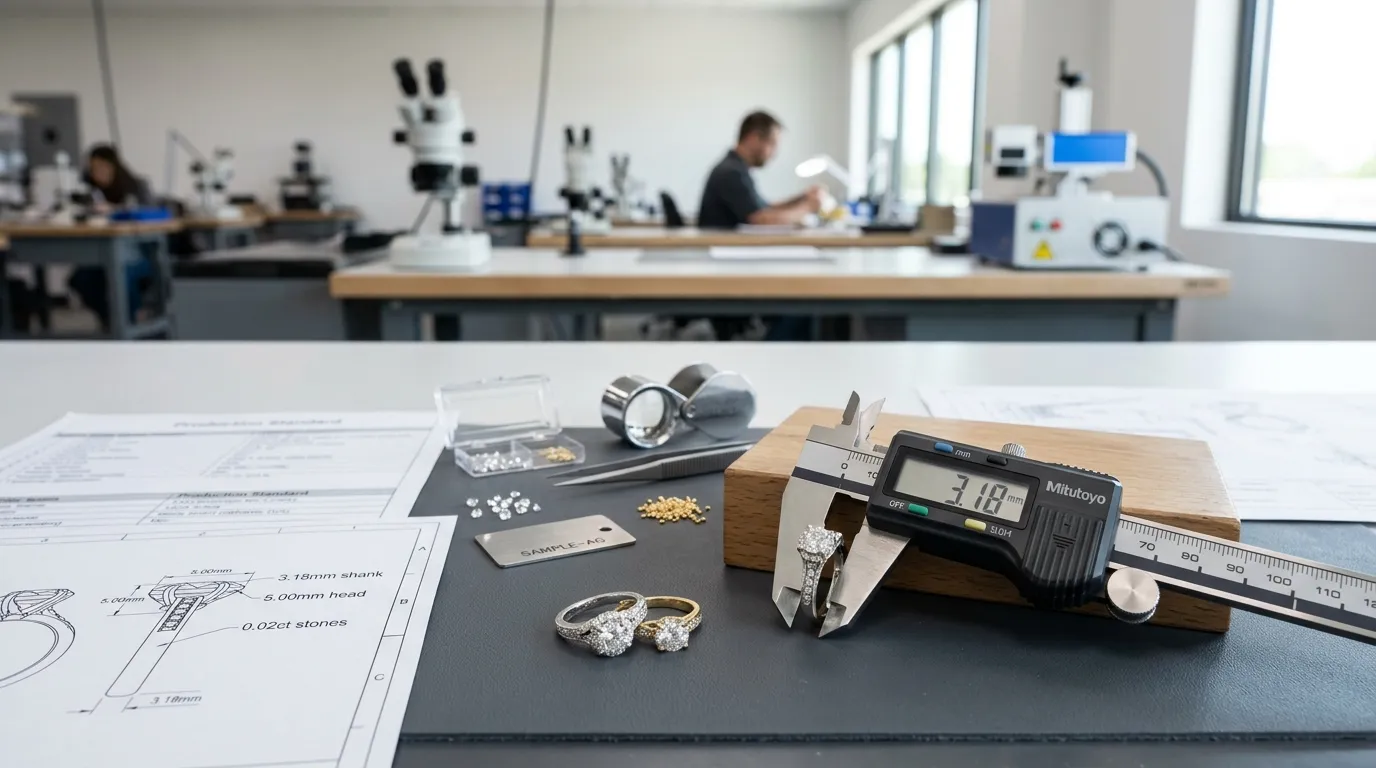
A jewelry production order needs to do more than tell us what product you want and how many pieces you need.
Before production starts, we need enough information to understand what should be made, how it should be made, what the finished product should look like, and how the finished pieces should be inspected.
If important details are missing, assumptions may enter the quotation, sampling, or production process. Those assumptions can later become differences in cost, appearance, dimensions, finishing, or delivery requirements.
At SSJew, we work with B2B brands on CAD, sampling, material control, finishing, production, and quality inspection. Our manufacturing workflow is designed to move a product from a confirmed design into a production reference that can be used for bulk manufacturing and future orders.
So, before you send your jewelry production order, make sure the following information is clear.
What Your Jewelry Manufacturer Needs Before Production
A useful production order connects several types of information:
Product design + material + dimensions + construction + finish + quantity + packaging + QC requirements.
You do not necessarily need to have every technical detail finalized before the first conversation with us. Some details are normally developed during CAD and sampling.
However, the earlier you identify the important requirements, the fewer assumptions need to be made later.
Your production information should answer five basic questions:
-
What are we making?
-
What materials and components should we use?
-
What should the finished jewelry look and feel like?
-
How should the product be checked?
-
What quantity and commercial requirements apply to the order?
10 Things to Include in a Jewelry Production Order
1. Product Design and Reference Files
Start with the clearest design information available.
Depending on your project, this may include:
-
CAD files
-
Technical drawings
-
Product sketches
-
Reference photographs
-
3D files
-
Dimensions
-
Existing samples
-
Logo artwork
-
Stone layouts
If you only have a sketch or concept, that is not necessarily a problem. We can use the available information as the starting point for CAD and sampling.
The important point is to distinguish between design intent and approved production specifications.
At SSJew, our CAD process is used to convert design concepts into production-ready structures, including dimensions, thickness, stone seats, tolerances, and other details that need to work in physical manufacturing.
2. Material Specification
Your order should identify the intended material whenever it has already been decided.
For example:
-
925 sterling silver
-
Brass
-
Gold
-
Gold-filled
-
Other specified materials or components
Material selection affects more than the material price. It can influence manufacturing methods, weight, finishing, plating requirements, and the final product specification.
If the material has not been finalized, tell us your target product positioning and requirements instead of leaving the material unspecified.
For B2B production, a clear material specification also becomes important when you reorder the same product. SSJew's material system uses defined specifications and batch-based material management to support consistency across bulk and repeat orders.
3. Dimensions and Target Weight
Dimensions are among the most important manufacturing inputs.
Depending on the product, you may need to specify:
-
Length
-
Width
-
Thickness
-
Diameter
-
Ring size
-
Chain length
-
Stone size
-
Hole positions
-
Component dimensions
-
Target or reference weight
You do not need to define every tolerance yourself if you are not familiar with jewelry manufacturing.
Instead, identify the dimensions that are commercially important to you and ask us to review manufacturability during CAD and sampling.
This is especially important for pieces where changing thickness or weight can affect appearance, strength, cost, or wearing comfort.
4. Construction and Manufacturing Method
Your design does not always determine the manufacturing method by itself.
Depending on the product structure, production may involve casting, stamping, CNC machining, assembly, polishing, stone setting, or a combination of processes.
You may already know the preferred process, but if you do not, we can review the design and determine a suitable production route.
The important information for your order is therefore not simply “use casting” or “use CNC.”
It is the required product structure and performance, so the manufacturing route can be evaluated against the design.
At SSJew, our production workflow includes CAD review, sampling, forming processes, stone setting, finishing, plating and QC checkpoints.
5. Surface Finish
Your production order should describe the required surface appearance.
For example:
-
High polish
-
Mirror polish
-
Matte
-
Brushed
-
Textured
-
Sandblasted
-
Combination finishes
A product photograph can help us understand the visual direction, but it may not fully communicate the surface preparation required to reproduce that appearance.
During sampling, you can review the physical result and confirm whether the finish matches your expectation before bulk production.
Our materials and finishes workflow follows this principle: align the finish target, approve a working sample, carry the approved standard into production, and keep the same reference for future reorders.
6. Plating and Color Requirements
If your jewelry is plated, do not describe the requirement only as “gold plated” or “silver color.”
You should clarify the intended color and finish direction and, where applicable, the plating specification agreed with your manufacturer.
Plating also depends on the surface preparation underneath it. If polishing, cleaning, or preparation changes, the final appearance can change even when the nominal plating color is the same.
At SSJew, plating and finishing are integrated into our manufacturing workflow so finish direction can be reviewed as part of production rather than treated as an isolated final step.
7. Stone and Component Specifications
If your jewelry contains stones or other components, identify them clearly.
Your production information may need to include:
-
Stone type
-
Shape
-
Size
-
Color
-
Quantity
-
Setting position
-
Component type
-
Clasp or closure
-
Chain
-
Findings
For detailed products, stone placement and setting can affect both appearance and production feasibility.
We use sampling to review physical details such as stone spacing, structure, finish, and overall balance before larger production.
8. Branding and Packaging
If you are developing private-label jewelry, include your branding requirements separately from the core product specification.
This may include:
-
Logo position
-
Engraving
-
Logo method
-
Brand tags
-
Jewelry boxes
-
Pouches
-
Cards
-
Labels
-
Inserts
-
Other packaging
At SSJew, we recommend stabilizing the product direction and approved sample before adding layers of logo and packaging revisions. Our private-label workflow connects product standards with logo application and packaging support.
9. Quantity and Order Structure
Your production order should clearly state the required quantity.
If you have multiple styles, colors, sizes, or plating options, separate them rather than providing only one total number.
For example:
Style
Material
Finish
Quantity
SKU A
925 Silver
Gold Tone
500
SKU B
925 Silver
Silver Tone
300
SKU C
Brass
Gold Tone
800
This makes the production scope clearer and helps avoid misunderstandings during quotation and order confirmation.
If your project is still at the sampling stage, separate sample quantity from bulk quantity.
10. Quality and Inspection Requirements
Your production order should identify any quality requirements that are particularly important to your product.
These may include:
-
Critical dimensions
-
Weight range
-
Surface finish
-
Plating appearance
-
Stone security
-
Logo accuracy
-
Functional points
-
Packaging requirements
At SSJew, our QC process includes incoming material inspection, in-line production checks, and final inspection. Bulk output can be compared with the approved sample for areas such as color, dimensions, finishing, stone setting, and packing.
This is important because quality control should not depend only on a final visual inspection.
Which Information Should Be Confirmed Before Sampling?
Not every production detail needs to be locked at the beginning.
A practical workflow is:
Design Reference → CAD → Sample → Buyer Approval → Production Specification → Bulk Production → QC
Before CAD, you may mainly need to provide your design intent, materials, reference images, dimensions, stones, and target finish.
During CAD and sampling, the physical structure can be refined.
After sample approval, more details should become fixed production references.
This distinction matters because you should not treat an early sketch as if it were already a final manufacturing specification.
At SSJew, the approved physical sample becomes a reference for the production workflow, helping connect the original design with bulk manufacturing and inspection.
How Your Production Order Becomes a Manufacturing Standard
The most useful production order does not disappear after the purchase order is confirmed.
It becomes part of the product's manufacturing history.
For example:
Design File
↓
CAD Version
↓
Approved Sample
↓
Material & Finish Specification
↓
Production Notes
↓
QC Requirements
↓
Bulk Production
↓
Repeat Order Reference
This becomes especially important when you reorder a successful product several months later.
You should not have to rely on someone remembering exactly how the previous batch was made.
Your approved sample and documented specifications should provide a repeatable reference.
SSJew's current manufacturing and materials workflows explicitly connect approved samples with bulk production and future reorders.
Common Mistakes When Preparing a Jewelry Production Order
Sending Only a Product Photo
A photo can communicate appearance, but it does not fully define material, dimensions, weight, construction, plating, or tolerances.
Saying “Same as Last Order”
If the last order was several months ago, this instruction may be ambiguous.
Identify the specific SKU, approved sample, CAD version, material and finish reference.
Changing the Specification After Sample Approval
If you change the material, dimensions, plating, stones, or construction after approval, you should treat the revised version as a new production reference.
Combining Different Products Into One General Requirement
Different products may require different materials, finishes, tolerances, and QC checkpoints.
Keep product-specific information separated.
Ignoring Future Reorders
If a product is intended to become a long-term bestseller, prepare its production information with future reorders in mind.
A clear first-order reference can make subsequent production easier to manage.
Jewelry Production Order Checklist
Before production begins, confirm:
-
Design files or reference images
-
CAD / technical drawing where applicable
-
Material
-
Dimensions
-
Target or reference weight
-
Construction requirements
-
Manufacturing method if specified
-
Surface finish
-
Plating color and specification
-
Stone specifications
-
Components and assembly
-
Logo requirements
-
Packaging requirements
-
Quantity by SKU/variant
-
Approved sample
-
QC requirements
-
Revision/version reference
-
Delivery and commercial requirements
If several of these items are still unknown, that does not necessarily mean you are not ready to contact a manufacturer. It means you should identify which details need to be developed through quotation, CAD, sampling, or technical review.