
Jewelry Manufacturing Cost Breakdown for Brands
Jewelry Manufacturing Cost Breakdown for Brands
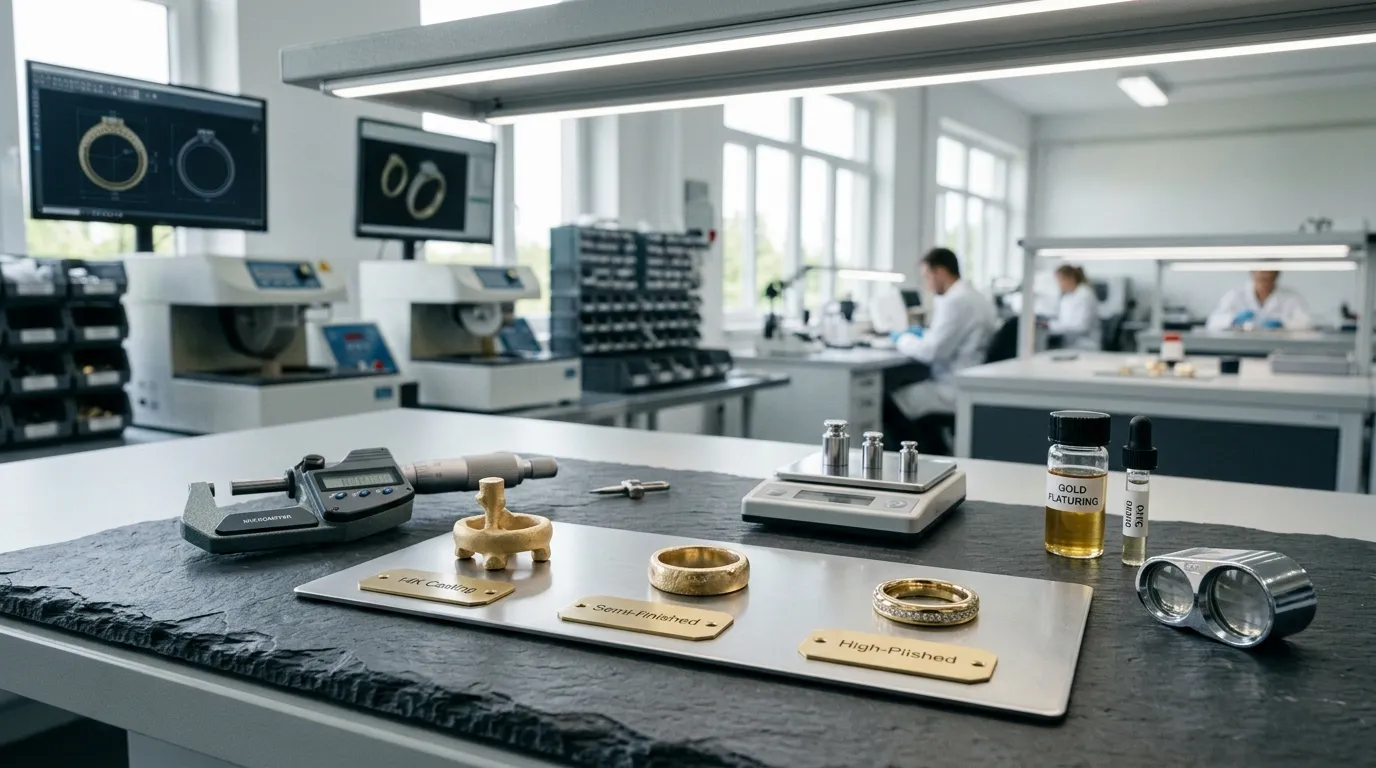
If you are developing jewelry for your brand, the factory quotation is more than a unit price.
Your final cost can be affected by the material, finished weight, production process, plating, tooling, order quantity, packaging, and quality-control requirements.
Two factories can quote different prices for the same design because they may be using different production specifications.
At our SSJew, we look at the manufacturing route behind your design before building a quotation. This helps connect your target cost with what can actually be produced consistently.
Why Do Brands Work Directly With Jewelry Manufacturers?
You Need Cost Control, Not Just a Low Quote
When you work directly with a jewelry manufacturer, you have more opportunity to understand what is included in your cost.
A quotation of $2.00 per piece is not automatically cheaper than $2.50 if the specifications are different.
For example, one quotation may include a particular plating specification, tooling and final inspection, while another may use different assumptions.
The important question is:
What exactly is included in your quoted cost per piece?
The Factory Determines More Than Your Unit Price
Your manufacturer influences how your design is converted into a production process.
CAD structure, casting, stamping, CNC, polishing, stone setting, plating and assembly can all change the amount of work required.
Our SSJew workflow connects CAD, sampling, material control, finishing and final inspection so your design can be reviewed before bulk production.
What Makes Up Your Jewelry Manufacturing Cost?
Material and Finished Weight
Material is one of the most visible cost drivers.
A 925 sterling silver piece, brass piece and gold piece have very different material costs. Within the same material category, your finished weight also matters.
For precious-metal jewelry, even a small change in finished weight can affect the cost of every piece.
-
Typical Finished Weight Range by Product Category: Rings: 1–8 g; Earrings: 1–6 g/pair; Pendants: 1–10 g; Bracelets: 3–20 g; Necklaces: 3–30 g; Chains: 5–40+ g.
-
Actual Material Loss / Scrap Rate: Target ≤5% for standard production, with higher rates possible for complex designs, casting, heavy polishing, or intricate stone-setting processes.
-
Material Cost Calculation Method: Material Cost = Net Material Weight × Applicable Material Price + Production Loss + Additional Material Costs. Recovered material is accounted for where applicable.
-
For reference, 925 sterling silver means the material contains 92.5% pure silver, according to the FTC's jewelry guidance.
Manufacturing Processes and Labor
Your design complexity can change manufacturing cost significantly.
A simple stamped pendant may require only a few major production operations. A detailed cast ring with stone setting, polishing, plating and assembly requires considerably more process control.
Typical cost components can include:
-
CAD and engineering
-
Mold or tooling
-
Casting or stamping
-
CNC machining
-
Polishing
-
Stone setting
-
Assembly
-
Quality inspection
Industry cost references commonly estimate labor at roughly 15–40% of unit cost, depending heavily on the design and number of operations. These figures are industry reference ranges rather than SSJew pricing.
Plating and Surface Finishing
Plating is another area where two apparently similar quotations can represent different specifications.
Your cost can change according to the finish, coating specification, surface area, preparation process and number of finishing stages.
The FTC notes that gold plating can wear over time depending on how the jewelry is worn and the thickness of the plating, which is why a specification such as simply “gold plated” may not be sufficient for a B2B production order.
At our SSJew, plating and finishing are connected with surface preparation and production inspection rather than treated as a final cosmetic step. Our manufacturing process includes plating control and finish matching for production consistency.
CAD, Tooling and Sampling
Custom jewelry often involves development costs before the first bulk order.
Depending on your design, this may include CAD development, 3D modeling, molds, dies, prototypes or sample revisions.
These costs should be separated from your recurring unit cost whenever possible.
Our SSJew process uses CAD and physical sampling before bulk production, allowing you to identify structural, dimensional and finishing issues before committing to a larger production run.
Quantity and Fixed-Cost Allocation
Order quantity also changes your effective cost per piece.
If a production setup costs $500, that cost represents:
-
$5.00 per piece at 100 units
-
$0.50 per piece at 1,000 units
-
$0.10 per piece at 5,000 units
The manufacturing process has not necessarily become five or fifty times cheaper. The fixed cost is simply distributed across more pieces.
This is why you should compare quotations at the same quantity and specification.
How Should You Evaluate a Jewelry Factory Quote?
Compare the Same Specification
Before comparing suppliers, make sure the quotation is based on the same:
Material + finished weight + dimensions + plating + stones + production quantity + packaging + tooling + QC requirements.
Otherwise, you may be comparing different products rather than different suppliers.
Separate One-Time Costs From Unit Costs
Ask whether CAD, molds, sampling, packaging setup and other development costs are included in the unit price or charged separately.
A transparent quotation makes future reorders easier to understand.
Our SSJew manufacturing workflow begins with requirement review and a confirmed production baseline, including material, finishing expectations, MOQ and production checkpoints.
How Can You Reduce Jewelry Manufacturing Risk?
Approve Specifications Before Bulk Production
Before approving bulk production, confirm the material, dimensions, weight, plating, stones, logo details, packaging and inspection requirements.
Your approved sample should then become the reference for production.
Our SSJew QC process checks materials, workmanship, plating, stone setting and packing against the approved sample through incoming, inline and final inspection stages.
-
QC Inspection Rate: 100% final inspection for finished jewelry, with in-process inspections conducted at critical production stages.
-
Actual Defect / Rework Rate: Target ≤2% for standard production orders, with corrective action and re-inspection applied to identified defects.
-
AQL Standard: ANSI/ASQ Z1.4 / ISO 2859-1 sampling inspection system; typical benchmark levels of AQL 1.5 for major defects and AQL 2.5 for minor defects, with critical defects at 0 acceptance.
How Do You Build a Long-Term Manufacturing Relationship?
Measure Repeatability, Not Just the First Quote
If you expect your jewelry styles to become repeat products, the first quotation is only the beginning.
You need a manufacturer that can reproduce the approved material, dimensions, finish and workmanship when you reorder.
Our SSJew manufacturing system is built around sample approval → controlled production → QC → repeat-order reference.
We currently operate with 200+ active craftsmen and monthly capacity exceeding 500,000 pieces, according to our published manufacturing information.
-
Repeat-Order Rate: 60%+
-
Average Reorder Period: 1–2 months
-
Customer Countries Served: 120+ countries
When you compare jewelry manufacturers, do not compare the unit price alone.
Compare what creates the price, what the quotation includes, how the factory controls production, and whether your approved standard can be repeated in future orders.
That is the difference between finding a low-cost supplier and building a controllable manufacturing supply chain.