
Jewelry Reordering Guide: Maintain Consistency Across Repeat Orders
Jewelry Reordering Guide: Maintain Consistency Across Repeat Orders
Jewelry Reordering Guide: How to Maintain Consistency Across Repeat Orders
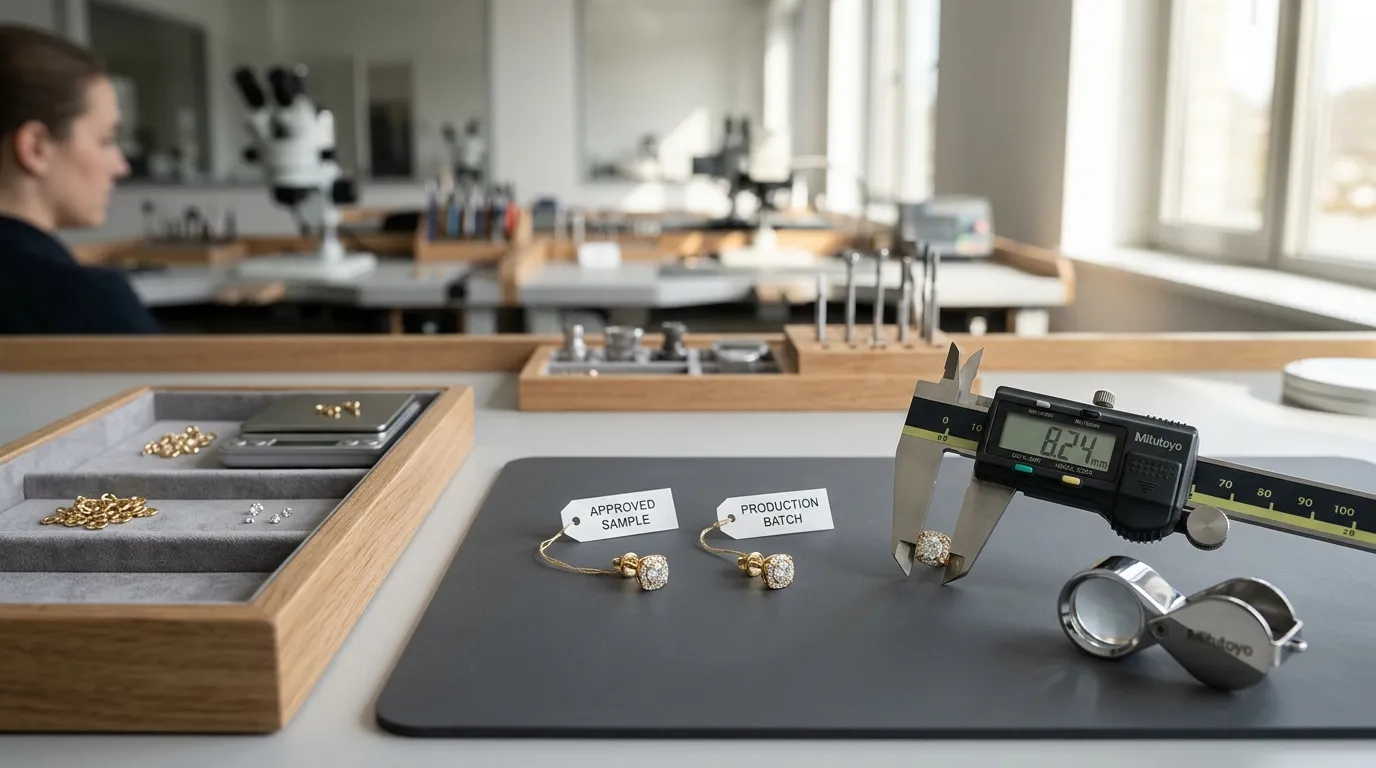
Your first jewelry production order may look exactly like the approved sample. The bigger challenge often comes later: Can your next order still match the same standard?
For a growing jewelry brand, repeat orders are not simply another production run. You may need the same dimensions, material, weight, plating color, surface finish, stone placement, logo position and packaging months after the original order was completed.
Sending the manufacturer the old product photo is usually not enough.
A successful jewelry reorder depends on keeping the approved production standard available and usable for the next batch.
At SSJew, we structure custom jewelry production around CAD, sampling, material control, finishing and final inspection, with the approved sample used as a reference for bulk production and future repeat orders. Our current manufacturing workflow specifically focuses on maintaining consistency from sample to bulk and into repeat production.
Why Repeat Jewelry Orders Can Differ From the Original Order
A repeat order can change even when the product name, design file or reference image has not changed.
Small differences can come from:
-
Material specifications
-
Metal weight
-
Dimensions
-
Casting or forming conditions
-
Polishing
-
Surface preparation
-
Plating color
-
Plating coverage
-
Stone setting
-
Assembly
-
Logo placement
-
Packaging
-
Production instructions
The problem is that some of these specifications may exist only in someone's memory or inside old conversations.
That creates risk.
If you want a product to remain consistent across multiple orders, you need to turn the first approved production into a repeatable manufacturing reference.
Start With an Approved Sample as the Production Reference
The approved sample should be more than a piece you use to approve the design.
It should become the physical reference for future production.
At SSJew, our current workflow uses the approved sample as a reference for production inspection, including comparisons of appearance, dimensions and finishing. Our QC process also connects inspection points to the approved sample before bulk orders are released.
What Should the Approved Sample Control?
Depending on your product, the sample should establish expectations for:
-
Overall dimensions
-
Product weight
-
Material
-
Surface appearance
-
Plating color
-
Plating specification
-
Stone placement
-
Stone setting
-
Logo position
-
Assembly
-
Functional components
-
Packaging presentation
Not every item needs the same tolerance.
A small variation in a non-visible internal area may be acceptable, while a visible logo position, stone alignment or plating color may require much tighter control.
The important point is that you and your manufacturer agree on what needs to remain consistent.
Why Photos Are Not Enough
A product photograph can show appearance, but it normally cannot define:
-
Exact weight
-
Material grade
-
Plating thickness
-
Internal construction
-
Dimensional tolerance
-
Stone-setting requirements
-
Production sequence
-
Packaging specifications
If you reorder a product using only a photograph, the manufacturer may have to interpret the production requirements again.
That creates unnecessary variation.
Your approved sample, CAD files and written production specifications should work together.
Define the Specifications Behind the Sample
Material and Weight
Material should be recorded clearly for repeat orders.
For example, if you originally approved a 925 sterling silver product, your reorder documentation should identify the same material requirement rather than simply saying “silver jewelry.”
Weight is also important.
If your first production batch has an agreed target weight, the next order should be checked against that reference where weight is commercially or structurally important.
A change in weight may indicate a change in construction, dimensions or material usage.
For gold and other higher-value materials, this becomes particularly important because weight can also affect your product cost.
Our custom gold manufacturing workflow emphasizes defining material direction and using approved samples as benchmarks for launch and future repeat orders.
Dimensions and Construction
Record the dimensions that matter commercially.
These may include:
-
Ring size
-
Pendant dimensions
-
Chain length
-
Width
-
Thickness
-
Stone seat dimensions
-
Clasp dimensions
-
Logo dimensions
You should also identify structural details that affect how the piece is manufactured.
A design that looks identical externally can still differ internally if wall thickness, hollow areas or connection structures change.
That is why CAD is useful for repeat production. It gives your manufacturer a technical reference instead of relying only on visual comparison.
Control Plating and Surface Finish
For many B2B jewelry products, finish consistency is one of the most visible parts of a repeat order.
You may need the next batch to maintain the same:
-
Gold tone
-
Silver tone
-
Surface gloss
-
Matte effect
-
Brushed texture
-
Polishing level
-
Plating specification
-
Surface preparation
“Gold plated” alone is usually not enough to define a repeat-order standard.
You should record the finish direction and any agreed plating requirements so the next production run does not start from a vague description.
SSJew's current manufacturing workflow includes in-house plating and checks for color difference, adhesion quality, exposed base areas and finish uniformity before final QC.
For repeat orders, this information should remain connected to the original approved reference.
Keep Stone Setting and Assembly Consistent
Stone-setting differences can be easy to notice after a reorder.
You may see variation in:
-
Stone position
-
Stone height
-
Prong appearance
-
Setting security
-
Stone alignment
-
Number of stones
-
Component placement
The same principle applies to assembled jewelry.
Clasps, links, jump rings, chains and other components should be identified clearly enough that the next order does not depend on memory.
If a component has been approved for the original order, record the specification rather than simply describing it as “same as before.”
Keep Production Notes Connected to the Product
Your reorder documentation should ideally connect several references:
Approved Sample + CAD + Material Specification + Finish Specification + Production Notes + QC Standard
This creates a clearer production history.
At SSJew, our current manufacturing process describes traceable inspection records and batch status connected to the order, while our materials and finishes workflow carries the approved reference from sampling into production and future reorders.
This is important because repeat-order consistency is partly a documentation problem, not only a production problem.
If the standard is not clearly recorded, even a capable factory has less information to reproduce it.
Control Repeat Orders During Production
Consistency should not be checked only when the finished products are ready to ship.
A stronger approach uses multiple checkpoints.
Incoming Material Checks
Before production starts, confirm that the incoming material matches the approved specification.
This can include:
-
Material type
-
Material grade
-
Components
-
Stones
-
Plating-related materials
-
Packaging materials
In-Line Production Checks
Problems are easier to control before they move through several additional production stages.
Depending on the product, checks may take place during:
Casting → Polishing → Stone Setting → Plating → Assembly
SSJew's current QC system describes incoming QC, inline QC and final QC, with workstation checks during casting, polishing, plating and stone setting.
Final Inspection
Before shipment, the finished batch should be checked against the agreed production standard.
Relevant checks may include:
-
Appearance
-
Dimensions
-
Weight
-
Plating
-
Surface finish
-
Stone setting
-
Function
-
Quantity
-
Packaging
SSJew's current manufacturing page states that final QC covers appearance, dimensions, weight, stone security, function points, quantity and packing readiness.
Your exact inspection standard should still be defined for each project:
QC inspection scope: 100% finished pieces + critical in-process inspections
AQL standard: ISO 2859-1 / ANSI/ASQ Z1.4
Final inspection ratio: 100%
How SSJew Approaches Repeat-Order Consistency
Our approach is based on keeping the production reference connected from development to reorder.
The workflow is:
Design → CAD → Sample → Approval → Bulk Production → QC → Repeat Order
The approved sample is not treated as a one-time prototype.
It becomes part of the production reference used to evaluate future batches.
Our custom silver jewelry workflow, for example, describes using one approved sample as the reference for bulk production expectations and future repeat orders. Our brass workflow similarly positions the approved sample as a reference for QC, bulk execution and replenishment.
This matters because the real question for a long-term supplier is not:
“Can you make this product once?”
It is:
“Can you reproduce the same agreed product standard when I reorder it?”
Your Repeat-Order Checklist
Before placing your next jewelry reorder, confirm:
Area
What You Should Confirm
Sample
Which approved sample is the reference?
CAD
Is the correct final CAD file being used?
Material
Same material and grade?
Weight
Same target or agreed range?
Dimensions
Same key measurements?
Plating
Same color and specification?
Finish
Same polish, texture and surface appearance?
Stones
Same stone type, size and placement?
Logo
Same position and dimensions?
Components
Same approved components?
Packaging
Same packaging and labeling?
QC
Same inspection requirements?
Records
Are previous production notes available?
If any of these specifications have changed, confirm the change before production starts.
Do not assume that “same product” means “same production specification.”
Common Repeat-Order Mistakes
1. Sending Only a Product Photo
A photo cannot fully define manufacturing requirements.
2. Changing the Finish Without Updating the Reference
A small change in plating color or polishing can make a reorder look different even when the design is identical.
3. Treating the First Sample as a One-Time Approval
If the approved sample is not preserved as a reference, future production may lose the original standard.
4. Changing Materials Without Revalidating the Product
A different material can affect weight, appearance, finishing and manufacturing behavior.
5. Checking Only the Final Shipment
If the first problem is discovered at final inspection, correcting it may require more rework than catching it during production.