
Why Two Jewelry Manufacturers Give Different Quotes
Why Two Jewelry Manufacturers Give Different Quotes
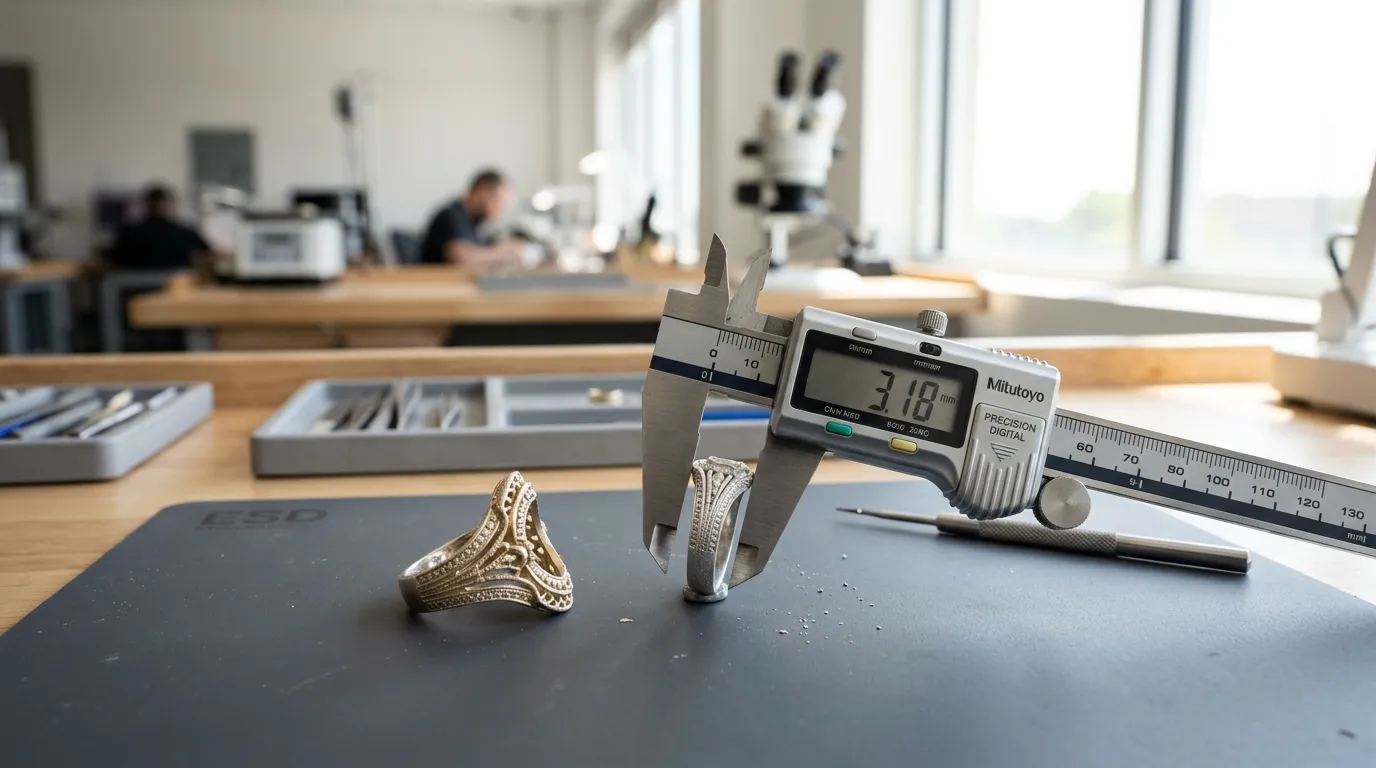
If you send the same jewelry design to two manufacturers, you may receive two very different quotations.
One factory may quote US$4.20 per piece, another US$3.80, and another US$3.40.
At first, the decision looks simple: choose the lowest price.
But before you compare the numbers, ask a more important question:
Are the three manufacturers actually quoting the same product and the same production scope?
A jewelry manufacturer quote is not determined by appearance alone. Material weight, construction, manufacturing process, plating specification, quantity, tooling, sampling, finishing, quality control, packaging, and commercial terms can all change the final quotation.
At SSJew, we treat custom jewelry as a manufacturing project rather than only a finished product. Our workflow connects CAD and sampling with material control, finishing and final inspection, so the production specification can be clearer before bulk manufacturing begins.
The Product May Look the Same but Be Specified Differently
Two pieces can look almost identical in a product photo while having different manufacturing specifications.
Material and Weight
Material is one of the most direct reasons for different jewelry quotations.
A 925 sterling silver ring weighing 5 grams does not have the same material cost as a similar-looking ring weighing 8 grams. The difference may come from thickness, internal construction, hollow versus solid areas, or design geometry.
The same applies to brass, gold and other jewelry materials.
When comparing quotations, you should confirm:
-
Material type and grade
-
Target or estimated weight
-
Solid, hollow or lightweight construction
-
Stones and components included
-
Findings and chains included
-
Any material substitutions
If one manufacturer assumes a lighter construction while another quotes a heavier version, comparing their unit prices directly can be misleading.
For precious-metal products, the material route can have an especially visible effect on the quotation because the metal itself represents a larger part of production cost.
Construction and Manufacturing Method
The same design can also be produced through different manufacturing routes.
Depending on the product, a manufacturer may use casting, stamping, CNC machining, assembly or a combination of processes.
For example, a relatively simple flat component may be suitable for stamping, while a three-dimensional design with complex geometry may require casting or CNC machining.
These processes involve different tooling, setup, labor and finishing requirements.
That means two factories can look at the same reference image and calculate different production routes.
The important question is not simply:
“Why is your unit price higher?”
Instead, ask:
“What manufacturing process and construction assumptions are included in this quotation?”
Plating and Surface Finishing Can Change the Quote
“Gold plated” is not a complete production specification.
A plated jewelry product can involve different preparation, coating processes, coating specifications and finishing requirements.
The U.S. Federal Trade Commission notes that gold plating can be applied through different processes and that the durability of gold plating depends partly on how the item is worn and the thickness of the coating.
For a B2B quotation, you should therefore clarify:
-
Base material
-
Gold karat
-
Plating color
-
Plating process
-
Plating thickness, where required
-
Underplating or barrier layers, where applicable
-
Surface preparation
-
Polishing standard
-
Final surface finish
If one factory calculates a basic plated finish and another calculates a more specified finishing process, their quotations will naturally differ.
At SSJew, finishing and plating are part of the manufacturing workflow rather than being treated as an isolated final step. Our production information specifically highlights material control, finishing consistency and final inspection.
Manufacturing Processes Change the Cost
The visible design is only one part of the manufacturing work.
A custom jewelry project may involve:
CAD → Prototype → Tooling → Casting / Stamping / CNC → Polishing → Stone Setting → Plating → Assembly → Inspection
Not every product needs every step.
CAD, Prototyping and Sampling
If you provide a production-ready CAD file, the manufacturer may have less development work to complete than when you provide only a product image or sketch.
A quotation based on a clear 3D model can therefore be different from one that includes additional design-development work.
Sampling can also be treated differently.
One supplier may quote the sample separately. Another may include part of the development cost in the project price. A third may quote CAD, prototype and tooling as separate one-time charges.
You should ask:
-
Is CAD included?
-
Is the prototype included?
-
Is the sample fee separate?
-
Are revisions included?
-
Is tooling required?
-
Who owns the tooling?
-
Can the tooling be reused for future orders?
This prevents a low initial unit price from being compared with a quotation that includes more development work.
Quantity and MOQ Change the Unit Price
Quantity is another major reason quotations differ.
Suppose a production setup creates a fixed cost of US$500.
At 100 pieces, that represents US$5 per piece.
At 1,000 pieces, it represents only US$0.50 per piece.
The actual setup cost has not changed. The cost allocation has.
This is why you should compare quotations using the same production quantity.
You should also clarify how MOQ is calculated:
-
Per order?
-
Per design?
-
Per size?
-
Per color?
-
Per plating finish?
-
Per material?
A supplier quoting 500 pieces across several styles is not necessarily comparable with a supplier requiring 500 pieces for each individual style or finish.
The MOQ structure can change the practical cost of launching a collection even when the quoted unit price looks attractive.
One-Time Costs and Recurring Costs May Be Quoted Differently
Another common reason for different quotations is how factories treat development costs.
One-Time Costs
These may include:
-
CAD development
-
Prototype
-
Mold
-
Tooling
-
Initial sample
-
Special setup
-
Development revisions
Recurring Costs
These may include:
-
Metal
-
Stones
-
Components
-
Production labor
-
Polishing
-
Stone setting
-
Plating
-
Assembly
-
Quality inspection
-
Packaging
If Factory A puts tooling into the first production quotation while Factory B quotes tooling separately, the first-order totals can look very different.
This does not necessarily mean one factory is more expensive.
It means you need to separate one-time project costs from recurring production costs before comparing suppliers.
Quality Control and Production Scope Can Be Different
A quotation can also differ because the production scope is different.
You should confirm what the quoted price includes for:
-
Surface inspection
-
Plating appearance
-
Stone setting
-
Logo placement
-
Dimensions
-
Weight
-
Assembly
-
Packaging
-
Final inspection
-
Rework handling
This matters because your cost does not end when the factory produces the first acceptable-looking piece.
If a bulk order has inconsistent plating color, loose stones, poor polishing or dimensional differences from the approved sample, you may face additional inspection, sorting, rework, replacement or delayed delivery.
At SSJew, our stated manufacturing workflow connects CAD and sampling, material control, finishing consistency and final inspection. Our current manufacturing page also describes the factory as operating its own manufacturing facility rather than outsourcing the entire production process.
For your project, however, you should still ask the manufacturer to define exactly what its QC process covers:
QC items: Material, Dimensions, Weight, Appearance, Plating, Stone Setting, Function, Packaging
AQL standard: ISO 2859-1 / ANSI/ASQ Z1.4
Final inspection ratio: 100%
Defect/rework rate: ≤2%
Do not assume that two factories with the same unit price provide the same QC scope.
How to Compare Two Jewelry Manufacturer Quotes
The easiest way is to normalize both quotations before making a decision.
Item
Manufacturer A
Manufacturer B
Material
Confirm
Confirm
Target weight
Confirm
Confirm
Construction
Confirm
Confirm
Stones/components
Confirm
Confirm
Manufacturing method
Confirm
Confirm
Plating specification
Confirm
Confirm
Surface finish
Confirm
Confirm
CAD
Included / Separate
Included / Separate
Sample
Included / Separate
Included / Separate
Tooling
Included / Separate
Included / Separate
MOQ basis
Confirm
Confirm
Production quantity
Confirm
Confirm
QC scope
Confirm
Confirm
Packaging
Confirm
Confirm
Shipping
Confirm
Confirm
Payment terms
Confirm
Confirm
Lead time
Confirm
Confirm
Only after these items are aligned does the unit price become genuinely useful.
A recent industry sourcing guide similarly recommends giving manufacturers the same design references, dimensions, material, finish, quantity and packaging requirements when comparing quotations.
What You Should Ask Before Choosing a Supplier
If two quotations are significantly different, send both manufacturers the same clarification questions.
Ask:
-
What material and estimated weight are you using for this quote?
-
What manufacturing process are you assuming?
-
What plating specification is included?
-
Does the price include CAD, sampling and tooling?
-
What is the MOQ basis?
-
What quantity was used to calculate the unit price?
-
What QC and finishing processes are included?
-
Is packaging included?
-
What shipping or commercial terms are included?
-
Will the approved sample become the reference for bulk production and reorders?
That final question is particularly important for brands planning repeat orders.
A sample should not only prove that one piece can be produced. It should establish a usable production reference for dimensions, appearance, material, finish, stone placement and other agreed specifications.
At SSJew, our custom manufacturing workflow is built around moving from design and sampling toward repeatable bulk production. Our current silver and gold manufacturing pages also emphasize using approved samples as references for bulk production and future reorders.